CHECCHI AND CO. CONSULTING, INC. (CCCI)
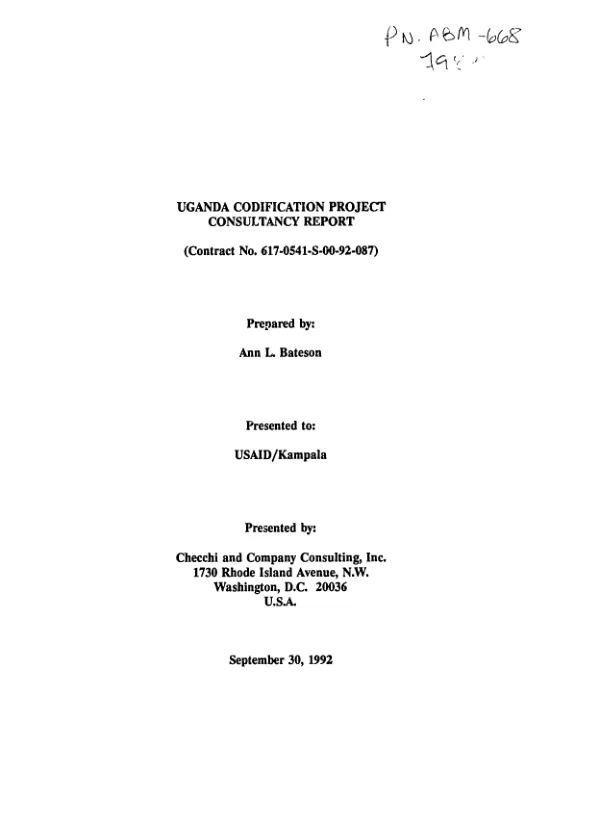
Uganda codification project consultancy report (contract no. 617-0541-S-00-92-087)
This report begins with an assessment of the current status and recent efforts at revision of the Ugandan codes.
Bateson, Ann L. · 1992
Sign in to readA free account is required to download.
Abstract
The Ugandan laws consist of principal and subsidiary legislation. The last compilation of these materials was made in 1964; since then, apart from the annual supplements that were published until the early 1970"s, individual legislative instruments have simply been published separately in the Uganda Gazette. Currently, no complete set of the laws of Uganda is available, apart from informal private compilations. Further, the reference system for these legal documents is inadequate, rendering highly problematic the finding of legal provisions and the tracking of amendments. In the 1970"s and early 1980"s, efforts were made to revise the consolidated laws of Uganda, but little remains of these efforts. Currently, The Laws (Revised Edition) Act, as amended in 1987, authorizes the revision/codification effort, but needs to be revised to take account of current realities and needs, as described further in the report. Several of the annexes to the report set out the inventory of existing laws (noting those repealed) for the purposes of the consolidation effort. The report discusses the idea of setting priority areas or categories of laws for compilation, but concludes that since any given sphere of activity engages a wide array of cross-cutting bodies of law, the only sensible and workable way to proceed is to undertake a complete revision and compilation of all the laws. Section V of the report presents the consultant"s estimation of the work requirements, including staff, outside experts, equipment and facilities, and an estimate of costs. Alternatives are discussed with respect to the persons who might play the leadership roles on the Ugandan side. The report concludes with a step-by-step suggested work plan, with an approximate range of required time for its completion and a discussion of outstanding issues that will affect the plan"s implementation, such as whether the project should be jointly funded by AID and ODA, and what the management structure might look like. (Author abstract)
Related documents