USAID DEC
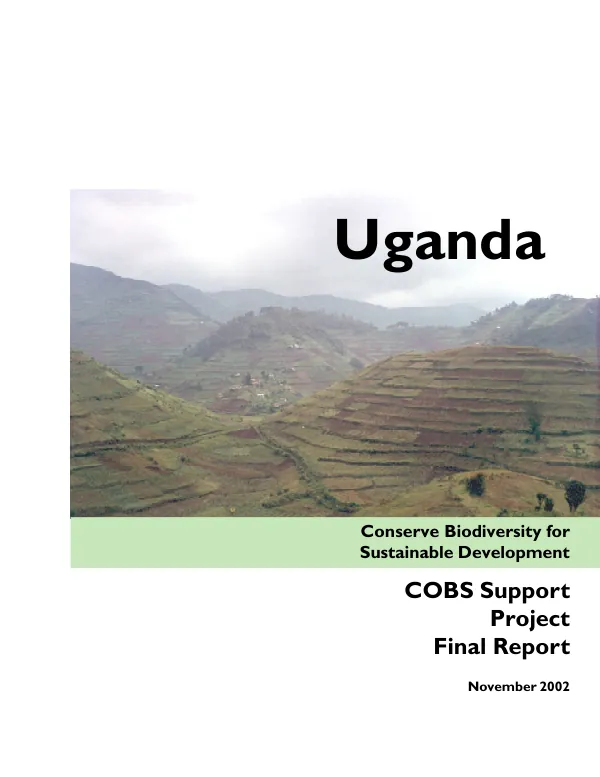
Uganda conserve biodiversity for sustainable development (COBS) support project : final report
Sign inASSOCIATES IN RURAL DEVELOPMENT, INC. (ARD)
Uganda conserve biodiversity for sustainable development (COBS) support project : final report
Final report of Associates in Rural Development, Inc.
Deshmukh, Ian · 2002
Sign in to readA free account is required to download.
Abstract
(ARD) on the Conserve Biodiversity for Sustainable Development (COBS) Program in Uganda (9/99-2/01). Activities were in four results modules (RMs): management of biodiversity conservation in protected areas (PAs); environmental planning and management in biodiverse landscapes/districts; capacity- building and institutional support; and special biodiversity support. Although results in RMs 1 and 2 were largely achieved, RM3 was less successful in contractual terms. RM3 was subjected to the largest changes as a result of a change in USAID focus from national-level interventions to local government capacity-building. The reduced contract budget also affected this RM more than the others. As a result, achieving national-level results under RM3 was no longer feasible in ARD"s view. On the positive side, RM1 helped the Uganda Wildlife Authority (UWA) develop an improved general management plan (GMP) system, as well as the GMPs themselves, which is now UWA"s adopted standard. Annual operation plans (AOPs) are leading to improved PA operations in several respects. Annual planning and budgeting are activity-based, and PA and UWA officer performance is judged against AOP expectations. Previously, field operations were often ad hoc and budgets simple line item lists, unconnected to activities or achievements. COBS support also worked with UWA and ECOTRUST to design and develop UWA"s first interpretative visitor information center in Queen Elizabeth PA. The center is not yet constructed, but ARD has prepared 80 interpretative panels that will be mounted when the center is finished. RM2 has developed what many observers believe is a ground-breaking approach to participatory, bottom-up planning through the local government system -- from parish to district. Environmental conservation is now being integrated into implementation of district development plans in the COBS districts. Capacity for planning and environmental management has been built in more than 150 government officials and 15,000 citizens. Implementation of district environment action plans (DEAPs) is underway through a series of project-supported pilot activities, and through a variety of locally active partners, including ECOTRUST, CARE, and UWA. A successful public information and education (PIE) campaign accompanied the COBS pilots, but a wider PIE effort was curtailed as a result of the budget cut. RM3 developed an innovative case-study approach to environmental impact assessment (EIA) training. The 84 local government officials and partners who received the training clearly benefitted; many subsequently applied the knowledge gained in their daily work. Other RM3 outputs included: environmental management awareness training at the parish level that reached more than 11,000 people, and an EIA manual published as a desk reference for public sector officials. RM4 provided critical and timely assistance to ECOTRUST during its early development. COBS support provided institutional support and capacity-building in a range of activities. Outputs included strategic and business plans, operational systems, and a much improved perspective on the Land Trust program. The Mission requested and received support for other aspects of the environmental strategic objective (SO) on four occasions. Overall conclusions are as follows: (1) Although impressive numerical results may be achieved, institutional change is equally important for sustainable results. (2) The DEAP process has made environmental management a priority issue and helped integrate environment into local government sectoral plans. (3) UWA, the National Environment Management Authority (NEMA), and local government -- not a transient project or its donor -- are the owners of the plans and processes developed. (4) There is a large gap between national planning and policy agendas and the needs and capacity of local government. (5) Working with local government -- political, technical, and administrative -- is highly productive, provided the engagement is one of genuine mutual benefit. (6) Local government is an integral component of society at local levels and is crucial when looking for landscape-level results through mobilizing community groups and private sector interests. (7) Changes of focus in project implementation should be guided by consultative processes and open communications. (8) COBS has laid a foundation for several activities envisaged for SO7 (expanded sustainable economic opportunities for rural sector growth).
Related documents
![Final report : draft -- [Bulgaria] GEF biodiversity project](https://covers.devme.ai/gen/14066.webp)