CHEMONICS
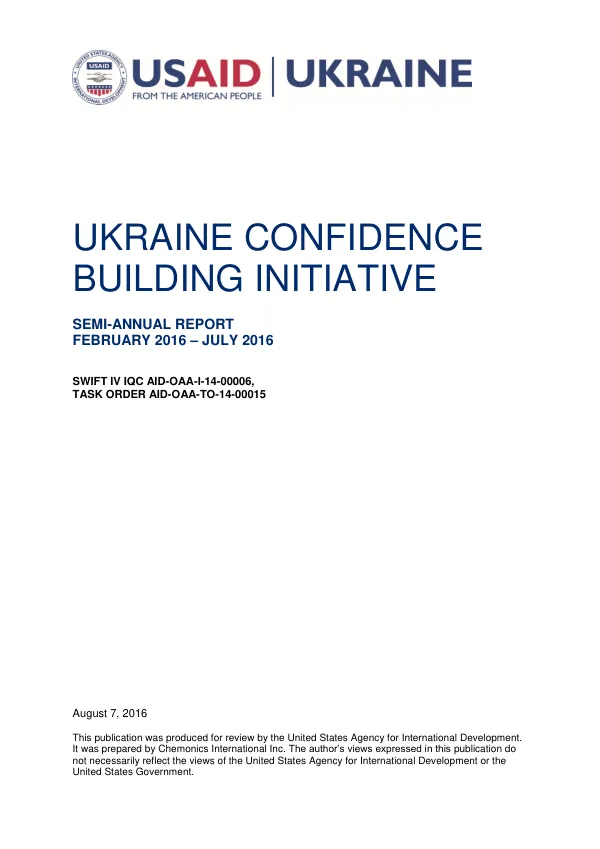
Ukraine Confidence Building Initiative Semi-Annual Report, FEB 2016-JUL 2016
The Ukraine Confidence Building Initiative (UCBI) was launched in July 2014 by USAID's Office of Transition Initiatives (OTI) in response to the socio-political upheaval facing the country.
2016 · 15 pages
Sign in to readA free account is required to download.
Abstract
The initiative aimed to complement ongoing USAID efforts to support a successful democratic transition and promote national cohesion in the wake of the conflict in the East. UCBI maintained a geographic and operational footprint in Kharkiv, Dnipropetrovsk, Zaporizhzhia, and Kyiv, as well as the liberated territories of Luhansk and Donetsk oblasts. During the period of February 2016 to July 2016, UCBI revised its program sub-objectives and increased its focus on the liberated areas, including the southern Donetsk city of Mariupol. The initiative provided small, in-kind grants and fixed amount awards to a range of partners, including national and local civilian government entities, civil society organizations, and community leaders. UCBI's programming was guided by analysis of local dynamics and geographic regions, with activities addressing each sub-objective varying based on assessed needs and opportunities. The initiative had three main objectives: to increase the capacity of vulnerable communities to manage tensions exacerbated by the conflict in the East, to increase constructive engagement between government and citizens at the local level, and to increase citizen resilience against divisive and biased information. Sub-objectives included increasing support for an inclusive definition of Ukrainian identity, enabling participation of conflict-affected groups in public, economic, and political life, and increasing demonstrations of reform by members of local government. The country context during this period was marked by ongoing political crisis, with Ukrainian Prime Minister Arseniy Yatsenyuk resigning in March 2016 and Volodymyr Groysman being appointed as the new Prime Minister. The de-communization process continued, with cities, towns, and villages across Ukraine being renamed. The release of Ukrainian pilot Nadiya Savchenko from Russian prison was a significant event, with her return to Ukraine being seen as a national hero. Despite efforts to implement the Minsk II Peace Agreement, little progress was made, with both sides continuing to violate the agreement. The OSCE mission in Ukraine reported that the core provisions for a political solution, including constitutional reform for local authorities in the separatist-held regions, remained unfulfilled. President Poroshenko held talks with the G5 leaders during the NATO Summit in Warsaw, Poland, where U.S. President Barack Obama reaffirmed the G5 leaders' strong support for Ukraine's sovereignty and territorial integrity. Internally Displaced Persons (IDPs) continued to be a significant issue, with 1,785,740 IDPs registered in Ukraine as of June 6, 2016. A new study by the UN High Commissioner on Refugees (UNHCR) showed that host communities in Ukraine remained supportive of IDPs, with many intending to return home. UCBI's programming aimed to address the needs of IDPs and host communities, with activities focused on increasing support for inclusive definitions of Ukrainian identity, enabling participation of conflict-affected groups, and increasing demonstrations of reform by members of local government.