USAID. BUR. FOR POLICY AND PROGRAM COORDINATION. CENTER FOR DEVELOPMENT INFORMATION AND EVALUATION (CDIE)
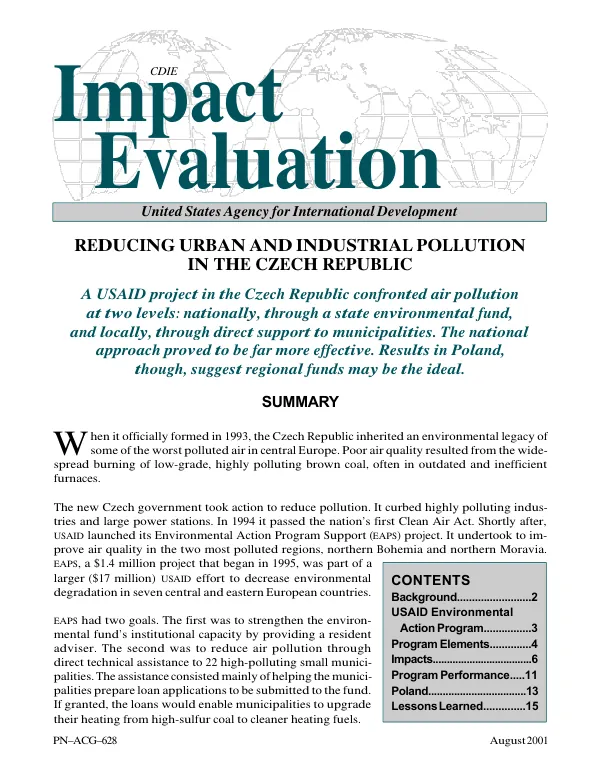
Urban and industrial pollution programs : Czech Republic case study
USAID"s Environmental Action Program Support (EAPS) project in central and eastern Europe was first implemented in the Czech Republic, beginning in March 1995.
Addison, Matthew; Forbes, Keith · 2001
Sign in to readA free account is required to download.
Abstract
The objective of the program was to strengthen the newly established Czech State Fund for the Environment (SFZP) and to help small municipalities mitigate pollution from energy utilities and local industries, e.g., by converting energy utilities from high sulfur coal to natural gas. A long- term residential adviser was placed at the SFZP (also known as the Fund). TA was provided to 23 municipalities in northern Bohemia and northern Moravia (two environmental hotspots) to help them develop loan applications to the Fund. This case study of EAPS in the Czech Republic revealed strong evidence that the SFZP was significantly strengthened as a result of EAPS guidance. The project prepared nearly a dozen studies to help the Fund understand and move toward major policy and operational improvements. Many of the resulting recommendations were adopted and implemented. EAPS support and recommendations allowed the Fund to increase its annual environmental loan portfolio by nearly $24 million, and as a result make substantial reductions in the discharge of major air pollutants nationwide. EAPS also helped municipalities prepare their loan packages, though many indicated that EAPS assistance in this area was not essential (most municipalities would have been able to obtain SFZP funding without project assistance). EAPS-assisted projects that received SFZP funding -- and upgraded their energy utilities or industries -- did reduce pollution, but much less so than what the Fund accomplished by adopting EAPS policy recommendations. With regard to helping other municipalities prepare loan packages, there was little evidence of replication beyond the targeted towns and cities. EAPS support to municipalities resulted in a one-time $3.2 million investment in new capital for environmental projects. Lessons learned from the EAPS experience in the Czech Republic are that (1) environmental regulations and meaningful enforcement are necessary first steps in improving air quality; (2) domestic environmental funds can be vital sources of finance for municipal projects in transition countries; (3) environmental investment evaluation and packaging can be an effective tool under some conditions, but measuring its success can be difficult; (4) replication at the municipal level can work, but requires an up-front strategy that takes into account the local context; and (5) for environmental funds to have the greatest societal impact, their dual purpose of financing and subsidizing socially desirable environmental investments must be emphasized. (Author abstract, modified)