MACRO INTERNATIONAL INC.
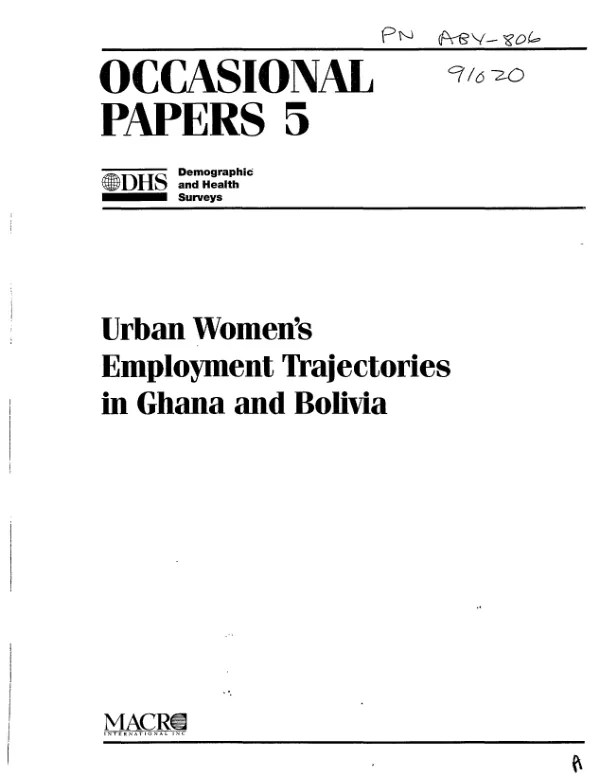
Urban women"s employment trajectories in Ghana and Bolivia
This study examines the employment of urban women in Ghana and Bolivia from two different standpoints: a single point of time as reflected in women"s current employment status, and a continuum, as reflected in women"s work trajectories defined across birth intervals.
Kishor, Sunita · 1996
Sign in to readA free account is required to download.
Abstract
The objectives are to understand how women in different cultural and developmental, but similar demographic contexts pattern their labor force participation over their reproductive lifecourse, and to compare what is learned about women"s labor force participation from their current employment with what is learned from their employment trajectories. Despite severe limitations imposed by data availability, this analysis provides meaningful insights into the nature of labor force participation of women and of the factors that influence it. Perhaps the most important finding is that no single theoretical model explains women"s labor force participation patterns. In Ghana, women"s current employment and the patterns in women"s labor force participation appear to be mostly independent of modernizing influences such as education; instead, cultural factors not captured by the tested models appear to account for the high levels of labor force participation and the differences in trajectories among Ghanaian women. In Bolivia, by contrast, current labor force participation and the patterning of labor force interaction are better correlated with both modernizing influences and life cycle factors. Includes references. (Author abstract)
Related documents
![Cebu longitudinal health and nutrition survey [CLHNS] : follow-up study -- final report](https://covers.devme.ai/gen/53185.webp)