USAID DEC
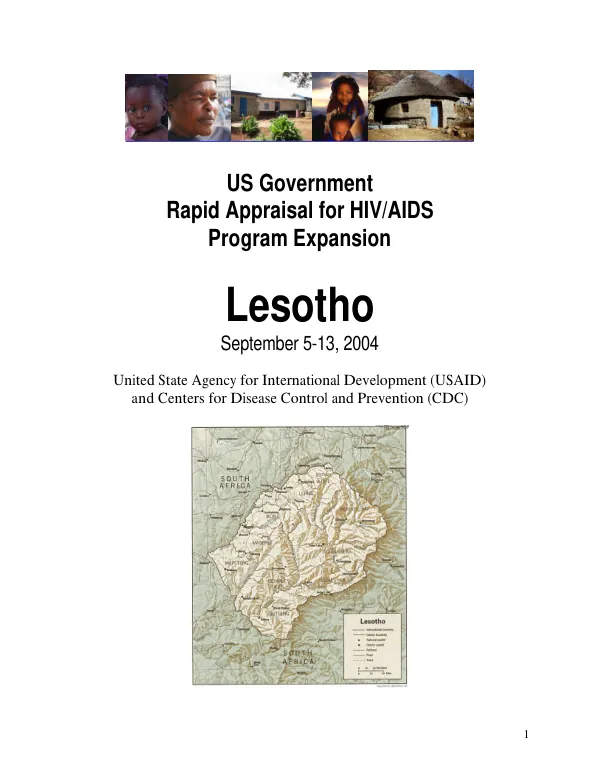
US Government rapid appraisal for HIV/AIDS program expansion : Losotho, September 5-13, 2004
Sign inCENTERS FOR DISEASE CONTROL AND PREVENTION (CDC) (U.S.)
US Government rapid appraisal for HIV/AIDS program expansion : Losotho, September 5-13, 2004
Lesotho currently does not have either a USAID or CDC-Global AIDS Program (GAP) office and is a non-focus country for the President"s Emergency Plan for AIDS Relief (PEPFAR).
1970
Sign in to readA free account is required to download.
Abstract
In recent years, through the Corridors of Hope Initiative, the Ambassador"s initiative on HIV/AIDS and other support to non-government organizations, the United States Government (USG), primarily through the regional offices of CDC and USAID, has emphasized prevention of HIV/AIDS among high risk groups such as migrant men, low income women, women working in the textile industry, truck drivers, taxi drivers, and female sex workers. Additionally, VCT and BCC projects have been supported. Anticipating increased funding for Lesotho for fiscal year 2005, a rapid appraisal of the USG strategy was conducted from September 5th to September 13th with a team comprising USAID, CDC and FHI technical staff from both Washington and the regional offices and a Senior Health Consultant from Lesotho. The major objectives of the rapid appraisal were to plan a joint USG strategy for Lesotho and to make recommendations for reorientation of the program within the context of a generalized epidemic. In addition, although Lesotho is not a focus country for the President"s Emergency Plan, it is receiving financial support through this initiative and can clearly contribute to and benefit from aligning itself with the Emergency Plan goals of treating 2 million PLWHA, preventing 7 million HIV infections and caring for 10 million PLWHA and orphans and vulnerable children by 2008. The rapid appraisal was not designed to be a formal evaluation of interventions previously or currently supported by the USG or other donors. The findings of the rapid appraisal team are presented in detail below. The team noted substantial opportunities for rapid expansion of HIV/AIDS activities. The people of Lesotho, referred to as Basotho, have a strong traditional system comprised of principle, area and local chiefs whom community members will first approach on social issues. They have a very solid cultural foundation of mutual assistance. They have survived numerous challenges with remarkable resilience and dignity. Lesotho is a small country with a homogenous population with one major ethnic group and language (Sesotho). Literacy rates are high (93.4 percent) among women and relatively high (72.6 percent) among men. Despite the mountainous geography of Lesotho, a relatively good transportation system and health care infrastructure provide a solid foundation upon which to build. Lesotho is also currently seeking opportunities to utilize its strong community structures and networks to even greater advantage. A cadre of community health care workers (CHCWs) was established in the 1970s and is being revitalized. In addition, an emerging model of support groups is showing great promise. (excerpt)