USAID. DIRECTORATE FOR POLICY. CENTER FOR DEVELOPMENT INFORMATION AND EVALUATION (CDIE). OFC. OF DEVELOPMENT INFORMATION
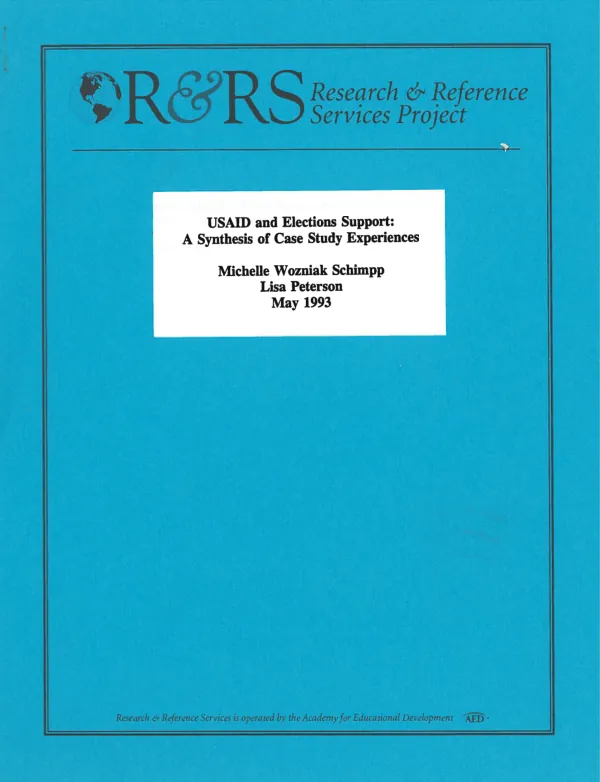
USAID and elections support : a synthesis of case study experiences
This review examines U.S.
Schimpp, Michele Wozniak; Peterson, Lisa · 1993
Sign in to readA free account is required to download.
Abstract
support for elections in 15 developing countries, including assistance in election monitoring, civic education, political party training, policy reform, and commodity procurement. The paper concludes that USAID and other donors have a sound understanding of how to use assistance effectively to support democratic elections; however, the long-term impact of this assistance on democracy and sustainable development is not well understood. The following conditions were found to most frequently influence the success of donor elections support. (1) Political parties must be committed to the democratic process and to respecting the election results. (2) Where present, democratic histories and traditions in a society will positively influence an election, and where absent, will exert a negative force. (3) The existence of a strong civil society increases the likelihood that elections will succeed. Voluntary organizations and nongovernmental groups constitute civil society and serve to link the individual and the state. During elections these groups can play an important role in election monitoring, civic education, holding elected officials and parties accountable, and in cases of fraud, protesting election results. (4) Two other determinants of election success -- the linkage between state and party, and the electoral system -- in 3 of the 15 case studies were altered through donor negotiations. Several tactics and tools have proven particularly effective. Timing is important -- involvement at least 3 months prior to an election is advised. Collaboration with other donors can prevent wasteful duplication and lessen suspicions on the part of host governments. A well-briefed international observer delegation can serve to reassure voters, deter certain types of fraud, and report on the fairness of the electoral process, whether or not the observed election is deemed successful or unsuccessful. Pre-electoral missions have been successful in encouraging electoral reforms, particularly when headed by prominent delegates, such as a former head of state. Assistance for nonpartisan domestic observers also serves as a long-term investment in democratic institution building, particularly in countries without high levels of ethnic divisiveness. Finally, parallel vote tabulations have been highly successful in verifying election results and forestalling violence in cases where official results are slow to be announced. Several overarching lessons emerged from the analysis. (1) Even if the election process is anticipated to be flawed, donors may be able to play a positive role by supporting the election. For example, the election can offer the opportunity for citizens to register discontent and for monitors to report fraud to the international community. (2) If international intervention is required to guarantee security during elections, the prospects for maintaining post-election security are grim. (3) Support for regional institutions can have wide-reaching benefits, such as improved information sharing and heightened pressure on incumbent governments to promote free and fair elections. The Center for Electoral Promotion and Assistance (CAPEL) in Latin America is one example. (4) A sensible distance between the U.S. Government and certain electoral support activities, particularly observer missions, can prove beneficial for guarding the independence of activities, as well as enabling U.S. embassies to retain leeway for negotiation during the postelection period. (Author abstract, modified)