ATLANTIC RESOURCES CORP.
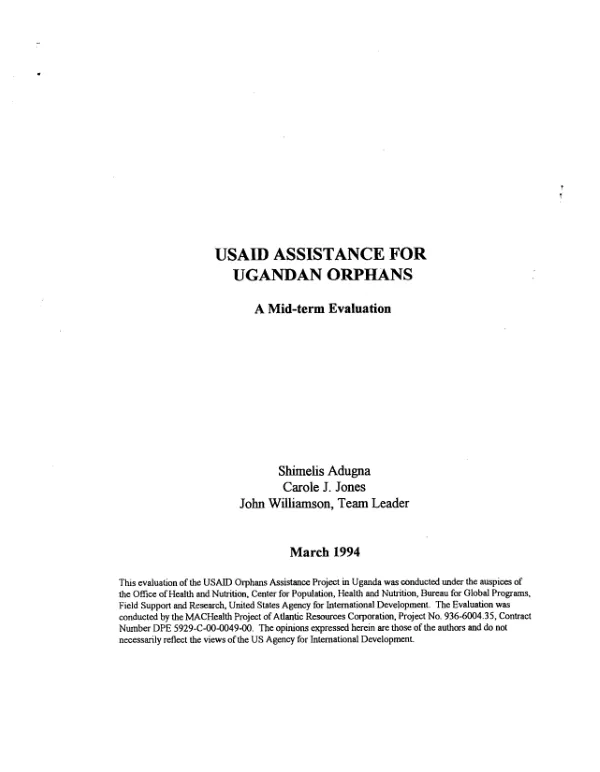
USAID assistance for Ugandan orphans : a mid-term evaluation
Evaluates USAID assistance to Ugandan children orphaned by war or the AIDS epidemic.
Adugna, Shimelis|Jones, Carole J.|Williamson, John · 1994
Sign in to readA free account is required to download.
Abstract
Mid-term evaluation covers the period 1989-3/94 and focuses on an umbrella grant to World Learning Inc. (WLI) and a grant to Save the Children Fund of the United Kingdom (SCF). WLI used the umbrella grant to provide subgrants to five Ugandan NGOs: the Uganda Women's Effort to Save Orphans (UWESO), Nsambya Hospital's AIDS Widows and Orphans Family Support Program (AWOFS), the Lira District Development Agency (LIDDA), the Church of Uganda's Diocese of Northern Uganda (DNU), and the Uganda Community Based Association for Child Welfare (UCOBAC). LIDDA and DNU, working in northern Uganda, have paid school expenses for orphans, provided agricultural inputs to families caring for orphans, and facilitated AIDS awareness and legal training; DNU has also provided small grants to help HIV-positive parents to start small businesses. DNU has done a good job of helping to get orphans into school, but urgently needs TA with income generation activities. LIDDA is progressing well. AWOFS, which has raised 46% of its budget from non-A.I.D. sources, has provided families having at least 4 children, and in which one parent attends an AIDS clinic, with income-generating assistance, counseling, and vocational training for children; AWOFS would benefit from technical support. UWESO, through its wide-reaching network, has paid the primary school expenses of 1,100 children in 24 districts, and vocational training expenses of 152 adolescents in 15 districts. It has also implemented a vocational program in fishing, which has been fairly expensive on a per capita basis. UCOBAC has extended 15 small grants to grassroots organizations for income generation and vocational training for orphans and the families caring for them. The grants, which have leveraged significant community resources, are the best examples seen so far of strengthening communities' capacities to support children whose families cannot. Overall, WLI funding has been equally divided between the payment of school fees and income generation. The evaluation team feels the emphasis should be on income-generation in order to build family and community capacity to pay for schooling and other basic needs. It is also recommended that revolving credit schemes be introduced; vocational training stress areas most likely to lead to employment and provide tools or equipment needed by graduates; and AIDS and legal training components be expanded. WLI's grant management was facilitated by its use of the structure already in place for USAID's AIDS Prevention and Control Program. WLI has effectively built subgrantees' financial management capacities; its weakness have included insufficient TA for income-generating activities, and poorly designed baseline surveys. Also, the dual administrative structure inherent in the umbrella grant mechanism, though advantageous in this type of project, is expensive. SCF has supported 3 main interventions: an exceptional program to resettle 1,418 children from residential institutions to families; establishment of an open and distance learning program, which has trained 220 personnel in over 40 children's homes; and increasing the capacity of the Ministry of Labor and Social Affair's department to protect vulnerable children. Weaknesses include inadequate preparation and follow-up of both children and families in the resettlement program and, in the distance training component, high turnover among orphanage personnel and lack of a mechanism for ongoing training. The following lessons were learned. (1) Given the growth of the AIDS epidemic, future efforts should focus on (a) strengthening the capacity of families to care for their children; (b) building community capacity to assist children whose families cannot meet their needs, including the development of child protection interventions; and (c) helping adolescent orphans to begin supporting themselves. Child protection interventions and relief measures will also be needed. (2) Income-generating initiatives must be economically sound. (3) Where needs and expectations are high, NGOs should make communities aware from the outset that resources are limited and should request community input in selecting beneficiaries. NGOs should also keep local government informed and involved. (4) A network of NGOs linked with government child welfare authorities can be a powerful vehicle for supporting child advocacy and protection. (5) The existence of cultural traditions for the care of orphaned children within the extended family does not ensure that children whose parents die will automatically receive adequate care. (6) Government child welfare authorities, provided with TA, can improve the situation of vulnerable children. (7) Laws and regulations governing children's institutions (including time limits for institutionalization) are critically important; regular compliance monitoring is essential. (8) Resettling children from institutions into new families can work, but should be accompanied by documentation for tracing, pre-resettlement counseling, and follow-up. (9) Distance learning for child care workers can be flexible and cost-effective, although participants need encouragement and support during their studies.
![Report on Displaced Children and Orphans Fund program in Gulu and Kitgum[, Uganda]](https://covers.devme.ai/gen/5578.webp)
![Report on Displaced Children and Orphans Fund program in Gulu and Kitgum[, Uganda]](https://covers.devme.ai/gen/106820.webp)
![Displaced Children and Orphans Fund : assessment of the POMMAR [Preveno orientada aos meninos e meninas em situacao de risco = Prevention oriented towards at-risk boys and girls] project in Brazil](https://covers.devme.ai/gen/5705.webp)