USAID DEC
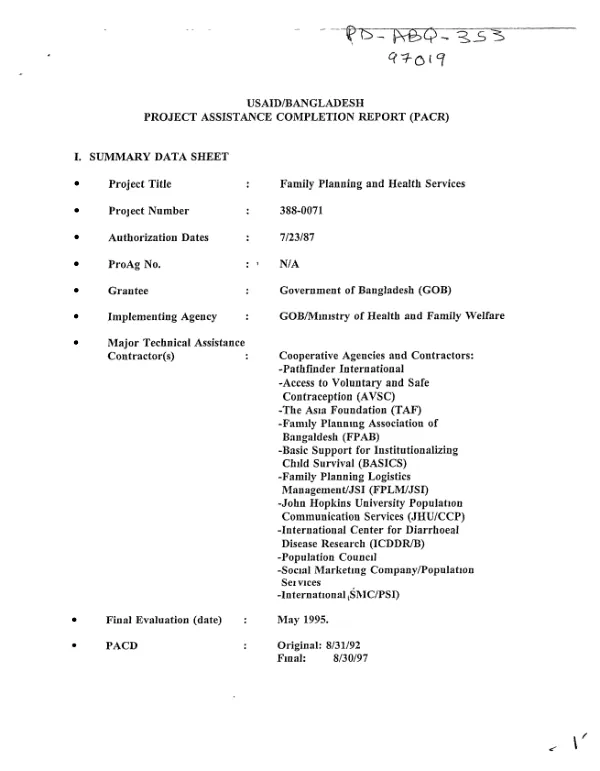
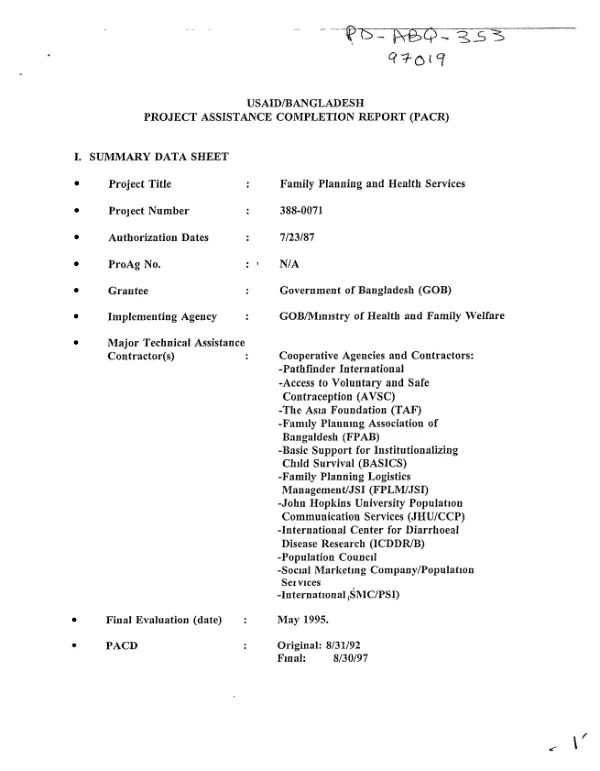
USAID/Bangladesh : project assistance completion report (PACR) -- family planning and health services
Sign inUSAID. MISSION TO BANGLADESH
USAID/Bangladesh : project assistance completion report (PACR) -- family planning and health services
PACR of a project (1987-97) to improve the coverage, quality, and sustainability of family planning/maternal child health (FP/MCH) services in Bangladesh.
1970
Sign in to readA free account is required to download.
Abstract
Through its support to the NGO, social marketing, and government sectors, this project contributed significantly to national efforts to reduce fertility and infant and child mortality. Overall, the project achieved or exceeded its goals and objectives and has been a major factor in the expansion of population and health services in Bangladesh. The project was organized under four components, some of which contained multiple subprojects. Component I focused on the public sector and aimed to improve and decentralize FP service delivery, strengthen logistics, and support the National Expanded Program of Immunization (EPI). Component II funded the Social Marketing Company (SMC) in promoting and distributing contraceptives and oral rehydration salts. Component III supported the delivery of FP/MCH services through NGOs. Under this component, there were cooperative agreements with three international and two national organizations. Component IV strengthened support services, including commodities logistics, research, evaluation, monitoring, and information, education, and communication (IEC). Overall, the project significantly contributed to increased use of FP, immunizations, and oral rehydration therapy to treat childhood diarrhea. It also led to significant improvements in contraceptive logistics, the functioning of the SMC, and the viability of local NGOs. Finally, operations research helped to achieve important policy reforms. Lessons learned are as follows: (1) Significant improvements in contraceptive prevalence and immunization coverage can be achieved with strong national commitment, adequate logistics, strong IEC, and attention to quality of services. (2) Quality is essential if health and FP programs are to be effective. Service quality can be improved by establishing and maintaining clear service standards, providing performance-based training based on these standards, maintaining regular and meaningful contact with customers, providing needed equipment and supplies, and improving all aspects of counseling. (3) IEC is a critical element for successful health and FP programs. IEC can effectively be used to keep all segments of society well informed about essential, affordable, preventive, and curative interventions. IEC can also be used to target clients at particular risk, for example, newlywed women or commercial sex workers. In addition, IEC programs can play a key role in making qualified providers of essential services easily identifiable and accessible to the general public. (4) Provided they have access to training, supplies, and supervision, local NGOs can be a very effective mechanism for delivering quality FP/MCH services to communities. (5) Improvements in contraceptive supply management are critical to the performance of FP service delivery programs. (6) Given the social transformation underway in Bangladesh, the national program should encourage women to seek FP and health services at health centers rather than wait for services to be delivered by fieldworkers at their doorstep. In addition, women can receive a much wider range of essential services at clinics than are available from community-based distribution programs. (7) Couples are willing to pay for accessible, high-quality, and affordable services. (8) Greater utilization of health facilities is possible when an integrated package of essential services is made easily accessible to clients. (9) Flexibility is needed in allocating resources among project activities. In addition, program documentation and approval processes should be streamlined. (Author abstract, modified)
![Innovations in family planning services [IFPS] project : midterm assessment report](https://covers.devme.ai/gen/5707.webp)
![Midterm evaluation of the PROFAMILIA [Asociacion Pro-Bienestar de la Familia Nicaraguense] diversification, sustainability, and social marketing grant](https://covers.devme.ai/gen/5467.webp)