USAID DEC
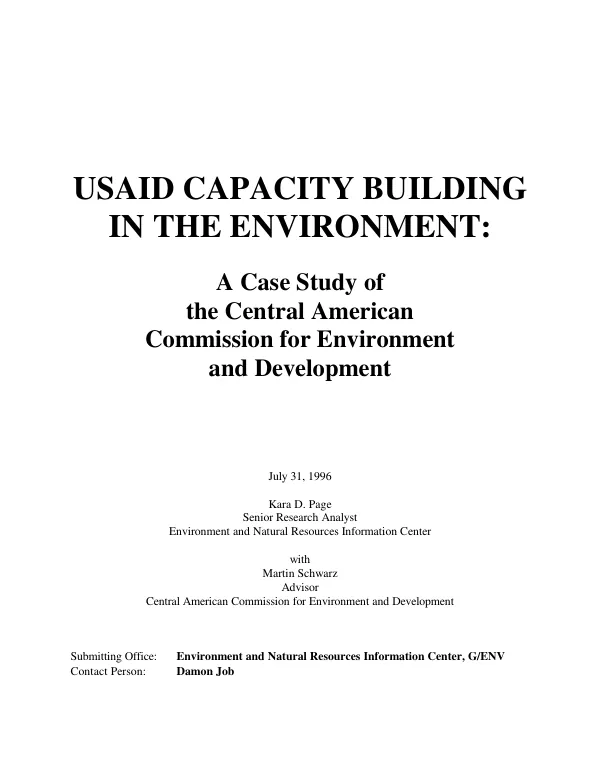
USAID capacity building in the environment : a case study of the Central American Commission for Environment and Development
Sign inCENTRAL AMERICAN COMMISSION ON THE ENVIRONMENT AND DEVELOPMENT
USAID capacity building in the environment : a case study of the Central American Commission for Environment and Development
Assesses the Central American Commission for Environment and Development (CCAD), which was established in 1989 as a regional mechanism for environmental cooperation.
Page, Kara D.; Schwartz, Martin J. · 1996
Sign in to readA free account is required to download.
Abstract
USAID has supported CCAD under the Regional Environment and Natural Resource (RENARMA) project and the Central American Regional Environmental project (PROARCA) from 1989 to the present. CCAD has become one of the most widely respected and influential institutions in Central America"s environmental and political arenas. Its size and mandate have grown over the years. CCAD manages a variety of programs and acts as a catalyst for regional discussions on which donors can build. CCAD"s advantages in this regard have enabled it to provide strong leadership in the development of other regional organizations, and have drawn attention as well from governments outside the region. CCAD"s specific accomplishments have included: coordinating the development of a regional plan to address tropical forest degradation (TFAP); coordination of the Central American Agenda presented at the June 1992 UN Conference on Environment and Development (UNCED); and acting as a driving force for institutionalization of the Central American Alliance for Sustainable Development (ALIDES). Although many agencies, individuals, and influences were involved in building CCAD, USAID"s assistance has certainly played a vital role, beginning with the provision of flexible program funding. USAID has also provided assistance through international environmental institutions and NGOs such as World Resources Institute and through its own on-site personnel. Counsel with high-level USAID regional staff has been an important factor in CCAD"s development. USAID"s support for CCAD teaches several lessons about capacity building: (1) the need to provide consistent and timely support; (2) the value of complementing direct support with indirect support (e.g., USAID"s Maya Biosphere project enhanced progress on CCAD"s initiative to create a biological corridor in Central America); (3) the importance of supporting local priorities (rather than imposing concerns from outside the region) and local leaders; (4) the importance of supporting appropriate institutional structures (early on, CCAD needed to stay small and flexible, but now as it expands it needs more developed internal organizational procedures); and (5) the value of CCAD"s emphasis on participatory environmental policy making. For example, CCAD"s involvement of NGOs, forest industries, women"s groups, and indigenous peoples in the Tropical Forestry Action Plan gave the process legitimacy across the wide spectrum of Central American society.
Related documents
Documents in this collection
 1970
1970USAID DEC
Municipality of Guatemala : design of an urban environmental management system (EMS) for the industrial sector of Guatemala City, phase I, 11 Dec 2000
Open record![CONCAUSA [Central America-US Joint Accord on biodiversity, energy, environmental legislation and trade and investment] in action](https://covers.devme.ai/gen/41339.webp) 1998
1998USAID DEC
![Promotion and adoption of environmental management systems : 10th of Ramadan Industrial City[, Egypt] : final report and action plan](https://covers.devme.ai/gen/83518.webp)