DAI
USAID COMPETE PROJECT MONTHLY REPORT APRIL 2018
The USAID Compete Project is focused on building the production capacity of firms to grow locally and expand regionally and internationally.
2018 · 20 pages
Sign in to readA free account is required to download.
Abstract
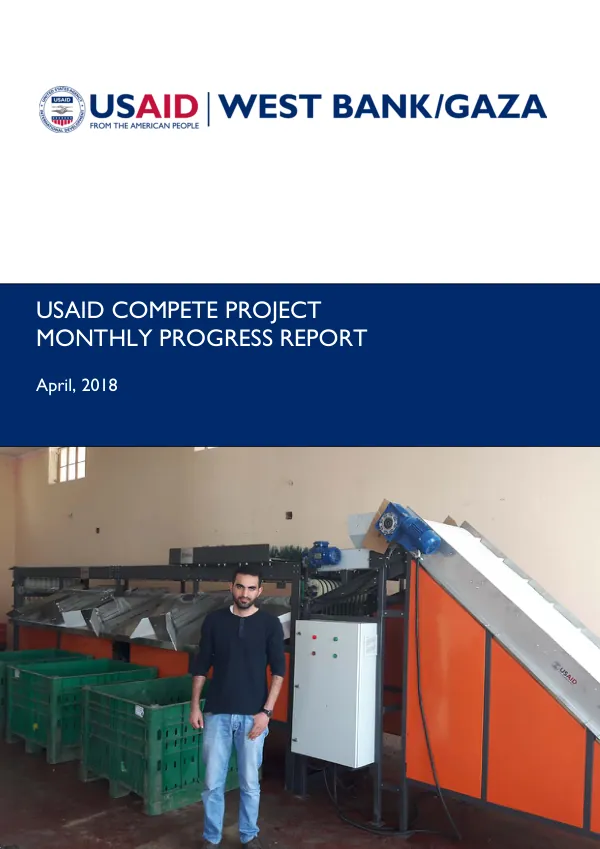
The project addresses key market failures to open the horizon for new value chains. In April 2018, the project continued to support the Agribusiness sector under the Firm Level Assistance Program (FLAP), with 1381 approved applications out of 4953 total applications. The project expanded its support for the baby cucumber value chain, working with farmers in Tamoun and the Deir Abu Da’if to create new clusters. USAID through its Compete Project signed an in-kind grant agreement with Al Torab Agricultural Company to support them with a baby cucumber sorting machine, which was delivered by the end of April. Additionally, the project supported Deir Abu Da’if farmers by establishing a packing house for sorting baby cucumbers, including a baby cucumber sorting machine to be delivered in early May. The project also announced a baby cucumber netting house program in the Northern West Bank, targeting baby cucumber farmers. 171 applications were approved, covering 314.5 dunums, with 60% of beneficiaries receiving netting. Furthermore, the project announced a seedless grapes program for supporting Y shape hanging systems in the Northern West Bank. The program approved 113 farmers, covering 431.5 dunums of seedless grapes, with the Y shape hanging system delivered to beneficiaries by April. In the fishing sector, Al Bahar sold 12.5MT of sea bream for markets in Gaza and the West Bank, while Fish Fresh total sales reached 11MT for local markets and West Bank markets. In Technology, Palestine Polytechnic University (PPU) concluded the design process for four machines, including a Vegetable Sorting Machine for baby cucumbers, which was manufactured by Al-Taqaddum Scales Co. in Hebron and delivered to Al Torab Company in Jenin by the end of April. In Stone and Marble, one company in Bethlehem showed results of USAID interventions, with Funoon Company supported with a sales representative and participation in trade shows in Qatar and Saudi Arabia. In the tourism sector, only one site renovation project was still in progress: the Rehabilitation of Haram Al Rameh archeological site in Hebron, with 50% completion expected by May 2018. In Gaza, the ICT sector continued to show progress, with eight LOAs signed, six of which were for developing the soft skills of 26 employees in the field of English for Business, management, marketing, and sales. The project also planned to enhance the ecosystems for business startups and small businesses through building the capacities for incubators/accelerators and business providers. In Textile and Garment, USAID through its Compete Project signed new LOAs with four garment companies to enhance their production capacity. As part of the Workforce Development Program (WDP), 19 apprentices ended the training period supported by USAID. Additionally, the project signed two grants with Mousa Mattar company and Iyad Abu Hasaneen company to enhance their production capacity. The Firm Level Assistance Program (FLAP) in the West Bank reached 2676 total applications, with 926 approved applications, 88% of which came from the agriculture sector. The project is currently supporting a range of activities, including large-scale programs in agriculture sectors identified as developing, particularly baby cucumbers and grapes. The project continued to work with farmers across the sector to enhance their productivity and facilitate trade through improved supply chain management. The baby cucumber clusters targeted pickling companies as well as selling baby cucumbers as fresh produce. USAID through its Compete Project expanded its support to work with farmers in Tamoun and the Deir Abu Da’if to create new clusters. The project also signed an in-kind grant agreement with Al Torab Agricultural Company to support them with a baby cucumber sorting machine, which was delivered by the end of April. The project's support for the potato program in Gaza has completed, with 57 farmers supported with drip irrigation systems covering 1753 dunums. The production of potato is estimated to increase by 5.2% with this new production system. The project also supports the sweet potato program through FLAP, with seven applications approved and signed LOAs. The sweet potato program aims to improve the sweet potato export to Israel, the West Bank, and Jordan by increasing the quality and quantity of sweet potato. The Gaza shading net program aims to introduce new vegetables production patterns by covering the plastic roof or insect net roof in greenhouses with 35% shading net. Eighty-nine applications out of 286 were approved, covering a total area of 295.75 dunums, with 85 of them signed the LOA. The project also assisted Deir Sharaf Agricultural Cooperative by implementing a pilot project for treated wastewater. Following the project announcement, 13 applications were received, with the pilot project expansion targeting eight farmers to establish additional 55 dunums, making the total number of pilot project around 200 dunums.
Related documents