DAI
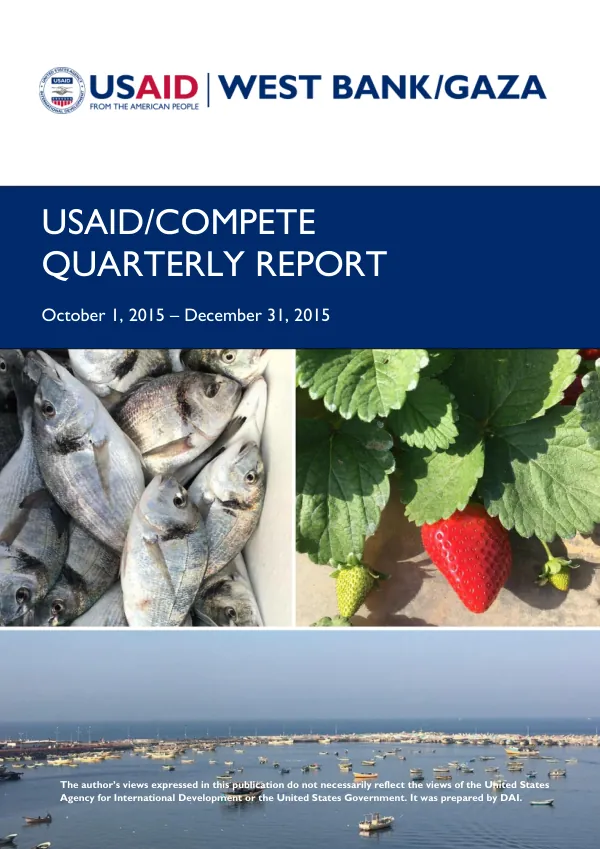
USAID/COMPETE QUARTERLY REPORT, OCTOBER 1 – DECEMBER 31, 2015
The USAID/Compete partnership with the Palestinian private sector has made progress in improving the competitiveness of Palestinian value chains.
2015 · 63 pages
Sign in to readA free account is required to download.
Abstract
Key market failures were identified at the value chain level for targeted West Bank and Gazan sectors, and the Project has addressed these failures using the Firm Level Assistance Program (FLAP) as the primary vehicle through which support is provided. In the West Bank, USAID/Compete concluded the design and started the implementation of activities that will introduce mushrooms and baby cucumbers as new value chains, unleashing market potential previously untapped in the agribusiness sector. The introduction of these new value chains is expected to improve the market position of Palestinian agribusinesses and increase their competitiveness. In the ICT sector, the Palestinian Internship Program has entered its third cycle, placing interns within high-tech companies. A group of trainees, mostly young women, were trained in SAP technology and solutions, and are expected to find employment opportunities with SAP affiliated companies locally and regionally. This initiative aims to improve the skills and employability of Palestinian youth in the ICT sector. The Stone and Marble sector is also benefiting from USAID/Compete's support, as the Project is introducing innovative products made from stone waste. This initiative turns environmentally damaging by-products into valuable commodities for the local Palestinian market, promoting sustainable practices and reducing waste. In the Tourism sector, USAID/Compete is working to improve the competitiveness of Palestinian tourism by supporting the development of new tourism products and services. The Project is also providing training and capacity-building programs for tourism stakeholders, including hotel owners and tour operators. The Gaza sector is also a focus area for USAID/Compete, with the Project working to improve the competitiveness of Gaza's value chains. The Project is providing support to small and medium-sized enterprises (SMEs) in Gaza, helping them to improve their productivity and competitiveness. The Firm Level Assistance Program (FLAP) is a key component of USAID/Compete's strategy to improve the competitiveness of Palestinian value chains. FLAP provides support to SMEs in the form of technical assistance, training, and capacity-building programs. The program aims to improve the productivity and competitiveness of SMEs, enabling them to access new markets and increase their exports. The Project's Gender and Youth Strategy is also an important component of USAID/Compete's work. The strategy aims to improve the participation of women and youth in the Palestinian economy, particularly in the private sector. The Project is providing training and capacity-building programs for women and youth, helping them to develop the skills and knowledge they need to succeed in the private sector. The Project's Monitoring and Evaluation (M&E) system is designed to track progress and measure the impact of USAID/Compete's interventions. The M&E system includes a range of indicators and metrics that are used to assess the Project's performance and identify areas for improvement. The Project's Communications and Outreach strategy aims to raise awareness about USAID/Compete's work and promote the Project's achievements. The strategy includes a range of activities, including media outreach, events, and reporting. The Project's Finance and Operations team is responsible for managing the Project's finances and ensuring that the Project is implemented in accordance with USAID's rules and regulations. The team is also responsible for managing the Project's subcontracts and grants, as well as its vetting process. Overall, USAID/Compete is making progress in improving the competitiveness of Palestinian value chains and promoting economic growth and development in the West Bank and Gaza. The Project's interventions are expected to have a positive impact on the Palestinian economy, particularly in the private sector.
Related documents