ABT ASSOCIATES
USAID Dairy Competitiveness Project in Rwanda
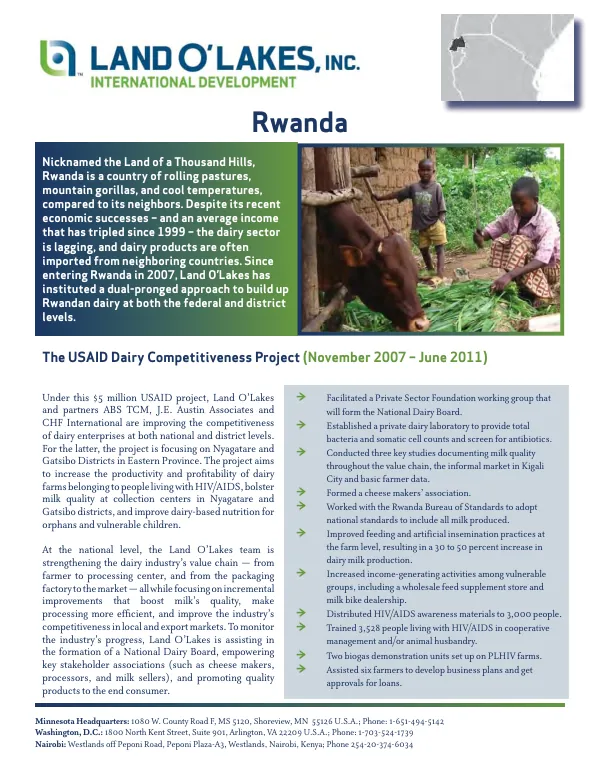
The USAID Dairy Competitiveness Project in Rwanda aimed to improve the competitiveness of dairy enterprises at both national and district levels.
2011 · 2 pages
Sign in to readA free account is required to download.
Abstract
The project, implemented by Land O'Lakes and its partners, focused on increasing the productivity and profitability of dairy farms belonging to people living with HIV/AIDS, bolstering milk quality at collection centers, and improving dairy-based nutrition for orphans and vulnerable children. The project's national-level interventions targeted the dairy industry's value chain, from farmer to processing center, and from the packaging factory to the market. Land O'Lakes strengthened the industry's competitiveness by focusing on incremental improvements that boost milk quality, make processing more efficient, and improve the industry's competitiveness in local and export markets. To monitor the industry's progress, the project assisted in the formation of a National Dairy Board, empowered key stakeholder associations, and promoted quality products to the end consumer. In Rwanda, the dairy sector is lagging, and dairy products are often imported from neighboring countries. Despite recent economic successes, the country's average income has tripled since 1999. Land O'Lakes has instituted a dual-pronged approach to build up the Rwandan dairy sector at both federal and district levels. The project facilitated a Private Sector Foundation working group that will form the National Dairy Board, established a private dairy laboratory to provide total bacteria and somatic cell counts, and conducted three key studies documenting milk quality throughout the value chain. The project also improved feeding and artificial insemination practices at the farm level, resulting in a 30 to 50 percent increase in dairy milk production. Additionally, the project increased income-generating activities among vulnerable groups, including a wholesale feed supplement store and milk bike dealership. The project distributed HIV/AIDS awareness materials to 3,000 people and trained 3,528 people living with HIV/AIDS in cooperative management and/or animal husbandry. Two biogas demonstration units were set up on PLHIV farms, and six farmers developed business plans and obtained loan approvals. The project's success stories include the story of Virginie Nyilihirwe, a secondary school teacher in Rwanda's Nyagatare District, who was able to double the amount of Napier grass she was producing with the help of a small grant from the Land O'Lakes Dairy Competitiveness Program. She was also provided with seeds for Mucuna and lablab forages, which she combined with Napier grass to provide fodder for her cow. Ms. Nyilihirwe is now producing so much fodder that she is able to sell the surplus and plans to use the revenue to purchase an improved dairy cow. Another success story is the milk bike, designed by Land O'Lakes USAID Dairy Competitiveness project. The milk bike, dubbed the café au lait bike, can carry between two and four 50-liter cans of milk and costs just over $200. Five bikes have already been sold, and a dealership has been established in an association for people living with HIV/AIDS. The project sponsored a first milk bike race, where contestants raced 1.4 kilometers loaded with 80 liters of liquid that weighed about 180 pounds. Winners received discounts on future purchases of bikes.