DATEX, INC.
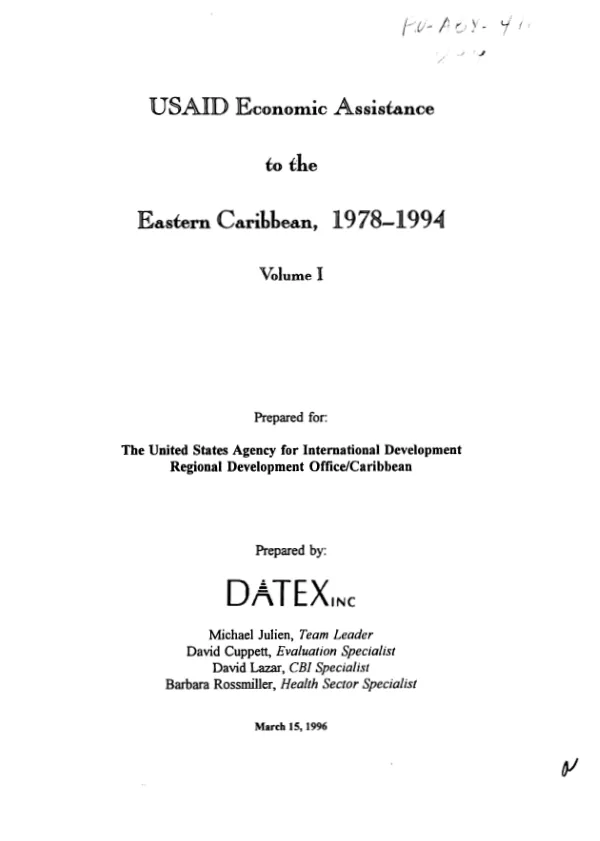
USAID economic assistance to the Eastern Caribbean, 1978-1994
Between 1973 and 1996, USAID provided $685 million in non-bilateral economic assistance to the Commonwealth Caribbean (CARICOM) region, of which $450 million supported development in member countries of the Organization of Eastern Caribbean States (OECS).
Julien, Michael|Cuppett, David · 1996
Sign in to readA free account is required to download.
Abstract
This retrospective assessment chronicles USAID's program from 1978, the year it established the Regional Development Office for the Caribbean (RDO/C) as a full Mission, through 1994, when the program entered its close-out phase; focus on the Eastern Caribbean. The Caribbean Regional Program included five core portfolios: (1) infrastructure ($194 million); (2) private sector ($170 million); (3) agriculture ($113 million); (4) training and human resources ($63 million); and (5) health and population projects ($36 million). It also included $55 million in special assistance to Grenada following the 1983 U.S. intervention. The program evolved in three phases: political and economic stabilization (1978-83); economic growth (1984-91); and global competition (1992-94). On the whole, the program was highly successful, taking on unprecedented challenges and diverse issues and forcing governments, donors, and institutions to rethink their approaches to development. In its early years, it successfully strengthened regional institutions, supported post-OPEC economic recovery in the small OECS states, and supported creation of the Caribbean Group for Cooperation in Economic Development (CGCED). The program had a lasting demonstration effect on private sector government, largely through its investment promotion and productive sector efforts. It strengthened OECS' capacity to address emerging trade, investment, and integration issues by helping the public sector to rethink conventional economic approaches and improve economic management systems. RDO/C was able to lead both the private and public sectors to place greater importance on human resources development through business management and skills training, and it helped the region make short- and long-term improvements in health, education, and infrastructure. Unquestionably, the Program had a positive impact on economic growth, especially during the 1980s, although targets may have been too ambitious given that the region did not have the capacity at that time to respond to the sudden trade and investment opportunities emerging out of the Caribbean Basin Initiative. However, RDO/C's manufacturing investment and employment generation activities created business opportunities and increased jobs and export earnings. Investment promotion efforts showed that the region needs to streamline its investment systems and adopt more favorable policies. USAID's export thrust identified the types of changes needed by the region to attract new investment (the region's failure to attract foreign investment in non-traditional agriculture confirmed its nascent status in that area). These activities led OECS governments, particularly in the Windward Islands, to re-assess their longer-term productive sector strategies. Efforts to encourage market reforms were only marginally successful; this was a key USAID priority in the 1990s, but was severely compromised by the decision to phase out RDO/C operations. The following lessons were learned. (1) Beneficiary countries are more receptive to programs that produce rapid results and reinforce established policies than they are to new ideas. USAID produced more positive results in the areas of economic management, human resources, health, and education than in the productive sectors. (2) The impact of capacity building is stronger than that of interventions to jump-start economic transformation. RDO/C's most durable results came from increased institutional capacity and changes in orientation of both the public and private sectors. (3) Economic transformation must be driven by the beneficiary countries themselves. RDO/C's efforts to encourage market reforms and diversification were less successful than expected due to the absence of consensus about the importance and urgency of the changes. This is especially true when countries lack the information systems and the human and financial resources to adopt such strategies. (4) Export and investment promotion efforts are important but not sufficient if the underlying policy framework does not provide a competitive advantage. OECS' preferential trade arrangements for traditional crops and industries mitigated against adoption of competitive economic development strategies. Consequently, without cost or other advantages to offer, efforts to stimulate investment faltered. (5) A regional approach to development assistance can be successful, at least where there is a regional identity and effort to address common problems through regional solutions. RDO/C's most important and durable successes were achieved in and through regional institutions. The level of influence and resources the United States was able to bring to the program may limit its replicability. Individual country Missions might have had more success in getting the national governments to adopt policy reforms, but this is far from certain.