USAID DEC
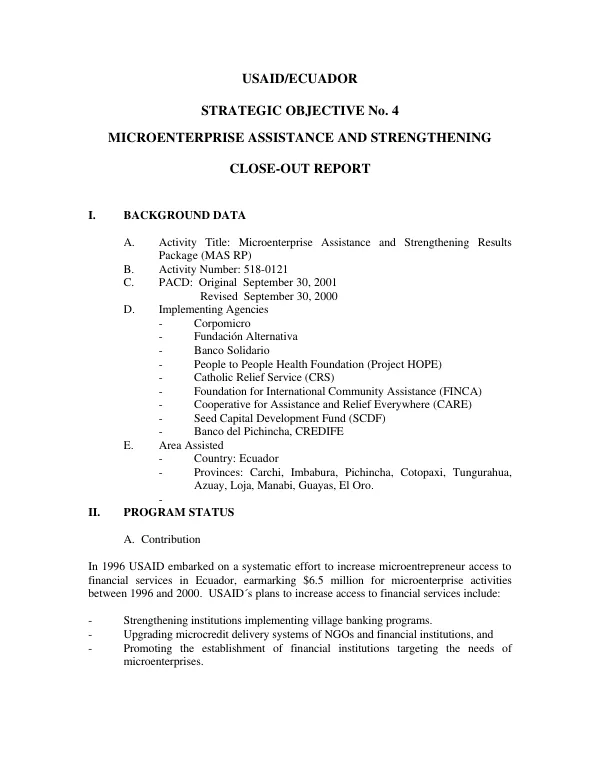
USAID/Ecuador : strategic objective no. 4, microenterprise assistance and strengthening -- close-out report
Sign inUSAID. MISSION TO ECUADOR
USAID/Ecuador : strategic objective no. 4, microenterprise assistance and strengthening -- close-out report
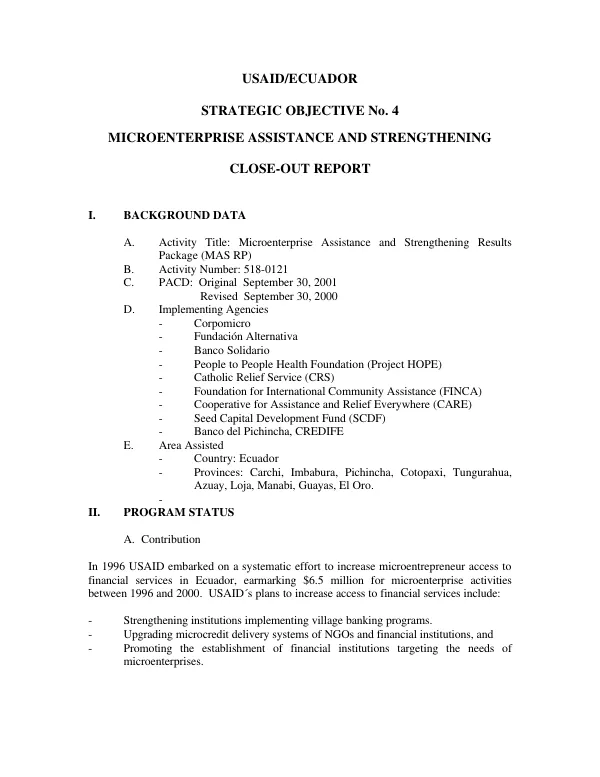
Close-out report on USAID/Ecuador's microenterprise assistance program (1996-9/00).
Sign in to readA free account is required to download.
Abstract
The program had six components: (1) USAID/Ecuador-Prime Fund made equity investment in Banco Solidario, Latin America's first privately-owned bank created to serve the microenterprise sector. This investment has catalyzed $2.5 million in additional funding. Consequently, Banco Solidario met its capitalization requirement and significantly improved its delivery to financial services to microentrepreneurs, opening 10 branches in suburban Quito and in smaller cities across the country. As of 9/30/00, it had 24,000 microentrepreneur borrowers. External TA was provided by Accion International through the matching grant project. (2) TA was provided by Coopers and Lybrand to CorpoMicro and four of its affiliate NGOs; emphasis was on upgrading management and information systems and developing strategic plans. A plan for improving the information systems of the four NGOs was developed and partially implemented in FY 1998. (3) Village banking activities grew significantly through cooperative agreements with Catholic Relief Services, People-to-People Health foundation (Project HOPE), and Foundation for International Community Assistance (FINCA). As of 9/30/00, 1,110 village banks were established, benefitting some 27,500 women entrepreneurs, far beyond the strategic objective target. (4) A grant of $400,000 was provided to Fundacion Alternativa for its training center for the staff of financial institutions engaged or interested in microcredit, including commercial banks, NGOs, and credit unions. (5) To encourage commercial banks to serve the microenterprise sector, Accion International was contracted to educate these banks on microenterprise best practices. USAID/Ecuador has successfully achieved the entry of one formal bank into the sector and initiated fundamental changes in the attitude of the formal, commercial banks toward microentrepreneurs, whom they have traditionally shunned. This institution, called CREDIFE, initiated operations at the end of 1999; as of 9/30/00, it had 2,500 microtenterprise clients. (6) A Latin American Challenge Investment Fund (LA CIF) was established in 5/99. This offshore microenterprise guarantee fund is expected to support activities in Latin American countries, especially in Ecuador. The microenterprise program has raised the standard of living of poor, marginalized families in 10 of Ecuador's 22 provinces and enabled them to invest more in education, health care, and other basic services. Almost 100% of village banking clients have been women; as a whole, 76% of the program's beneficiaries were women. Nevertheless, the banking crisis derailed new programs for USAID-assisted microenterprise lending by two large national banks. One of the largest surviving banks received training support with USAID funds and started its own microlending program through CREDIFE. In sum, the program reached 54,000 poor (and mostly women) clients with credit assistance, surpassing original targets. Two of the three village banking institutions achieved 100% self-sustainability by the end of FY 2000 and the third reached almost 80%, indicating excellent prospects for their sustainability. These partners were also working to identify new sources of funding to expand operations. Lessons learned include the following: (1) NGOs in Ecuador have structural weaknesses that limit their utility in developing stable financial intermediaries serving micro and small businesses. Legal prohibition on mobilizing savings deposits denies NGOs (except for cooperatives) access to domestic savings. Nonetheless, NGOs and credit unions can play an important role by creating innovative channels for reaching microentrepreneurs. (2) To survive, a second tier financing institution needs access to resources at sufficiently cheaper rates than do its first level borrowers. Careful financial planning is required before creating a second tier organization, to ensure that an economic niche for it exists. (3) Microentrepreneurs are able and willing to pay extremely high interest rates for short periods of time; this can make an attractive market for commercial lending. (4) NGO providers of credit have a limited range of financial services. Either the NGOs must consider a transition to a different type of financial structure to support the growth of their clientele, or other types of organizations must be encouraged to move in and meet this need. (5) The microenterprise universe is quite diverse and has different needs.
Related documents
Documents in this collection
 1970
1970USAID DEC
USAID/Ecuador : strategic objective no. 4, microenterprise assistance and strengthening -- close-out report
Open record![Katalysis North/South Development Partnership : matching grant II -- final evaluation : project no. 938-0155 [i.e. 938-0158] -- cooperative agreement no. FAO-0158-A-00-3043-00](https://covers.devme.ai/gen/45163.webp) 1998
1998USAID DEC
![Katalysis North/South Development Partnership : matching grant II -- final evaluation : project no. 938-0155 [i.e. 938-0158] -- cooperative agreement no. FAO-0158-A-00-3043-00](https://covers.devme.ai/gen/5592.webp)