PATH
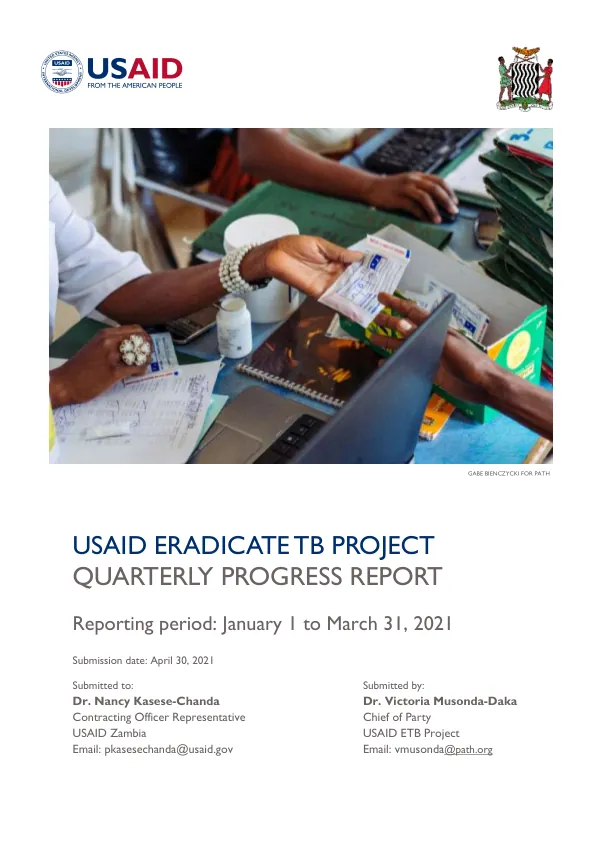
USAID ERADICATE TB PROJECT QUARTERLY PROGRESS REPORT
The USAID Eradicate Tuberculosis project continued to focus on high-priority and high-impact activities to improve performance in screening and treatment of drug-susceptible tuberculosis, childhood tuberculosis, and drug-resistant tuberculosis (DR-TB) during the second quarter of fiscal year 2021.
2021 · 55 pages
Sign in to readA free account is required to download.
Abstract
The project has noted an increase in laboratory testing, attributed to increased intensified case finding (ICF) activities aimed at contributing to the National Tuberculosis and Leprosy Control Program (NTLP) strategy of 55,000 TB notifications by December 2021. TB notifications have increased in ETB-supported provinces despite the COVID-19 pandemic, with the project surpassing its quarterly target with 6,661 TB notifications, representing 117% of the target. This is attributed to weekly TB Situation Room data review meetings, targeting of high patient-volume health facilities, and regular feedback and mentorship in 87 ICF activated health facilities. ETB observed a marginal decline in TB notifications through community contribution, from 2,790 (42%) in FY21 Q1 to 2,544 (40%) in FY21 Q2, due to reduced community activities during the surge in COVID-19 cases across the country. The proportion of TB notifications for children has continued to range between 6% and 7% in the past 12 months. To increase childhood TB notifications above the target of 10%, ETB will train mentors in childhood TB case detection and management, intensify contact tracing to target children, conduct decentralized health facility on-site mentorship, sensitize clinicians in use of stool for laboratory TB diagnosis, and TB screening in malnutrition wards, during Child Health Week campaigns, and maternal, newborn, and child health clinics in all six target provinces. ETB-supported facilities in six provinces continued to follow-up all patients on treatment to ensure favorable treatment outcomes. The project observed significant reductions in the proportion of patients who died, 2.6% in FY21 Q1 to 1.4% this quarter, and the treatment success rates was 92% in FY21 Q2, meeting the quarterly target. This is partially attributed to support for TB focal point persons with airtime to follow up patients, the efforts of 500 committed ETB-supported community-based volunteers who provide directly observed treatment support and referral for sputum tests, including TB treatment adherence counseling. In FY21 Q2, the project maintained 99% HIV testing rates among TB patients from the previous quarter, above the NTLP and ETB targets set at 95% and 96% respectively. Rates of linkage to antiretroviral therapy and care among TB/HIV coinfected patients also remained above the 96% target, with 97% recorded during the reporting period. ETB-supported provinces notified 52 rifampicin-resistant TB patients, representing 39% of its set target of 118 in the quarter under review, of which 50 (96%) were initiated on second-line TB treatment and linked to care. The project recorded 80% DR TB treatment success rate in FY21 Q2, which is a significant improvement compared to 63% DR TB treatment success rate recorded in FY21 Q1. The monitoring and evaluation (M&E) system for Eradicate Tuberculosis (ETB) ensures accountability through comprehensive analysis of key performance indicators against set targets. Data were collected from 341 health facilities across the six ETB-supported provinces, with ETB's performance on one of its key objectives, "Increase the number of individuals screened for tuberculosis (TB) in the target provinces by 50% from the baseline in 2016," noted testing above the target due to efforts to contribute to the National Tuberculosis and Leprosy Control Program (NTLP) annual target of 55,000 TB notifications. The project has increased intensified case finding (ICF) activities through health facility ICF activation, which involves orientation of health care workers (HCWs) to improve case detection and management. ETB will conduct DR-TB trainings for frontline health care workers at primary health facilities with high TB notifications, target retreatment patients to identify high-risk patients for DR TB, intensify DR-TB contact tracing, and subject all retreatments and other high-risk groups to GeneXpert, LPA, and culture.