USAID DEC
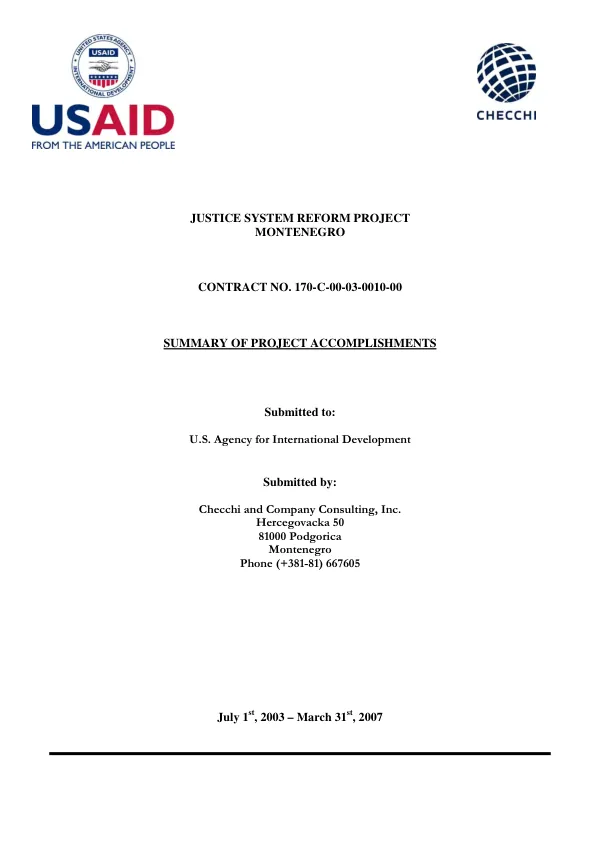
USAID/Haiti administration of justice project : final report -- contract no. 521-0238-C-00-5052-00
Sign inCHECCHI AND CO. CONSULTING, INC. (CCCI)
USAID/Haiti administration of justice project : final report -- contract no. 521-0238-C-00-5052-00
Final report of the contractor, Checchi and Co., on a project (1995-99) to improve the administration of justice in Haiti.
1999
Sign in to readA free account is required to download.
Abstract
Since the division of tasks among Checchi and others active in the sector had not yet been agreed to at the time of contract award, and the Government of Haiti (GOH) had not yet demonstrated its commitment to full-scale judicial reform, contract services were defined generically rather than specifically. For much of the first year of the contract, Checchi focused on establishing a legal assistance and information program; supporting the Judicial Training School; and building a case tracking system in six model jurisdictions starting in the prosecutors" offices. In the second year, support to the School was phased out and the focus of the case tracking initiative shifted to the court of first instance in Port-au-Prince and ultimately to the justice of the peace (JP) courts in the model jurisdictions. With the GOH on the threshold of replacing all judicial personnel and undertaking sweeping structural changes in the justice sector, new activities were added to support the momentum for reform, including a mentoring program for judges and TA in developing new operating budgets and salary structures. Consistent with the recommendations of a 1996 Internal Management Review of the project, all activities were grouped under three components: (1) strengthening the judiciary; (2) model jurisdictions; and (3) legal assistance and information. By mid-1997, it was apparent that the GOH was not ready to move forward with proposed reforms or increase budgetary support to the judicial sector due to lack of political will, legislative paralysis, resource constraints, and other factors. Accordingly, the project"s TA strategy was revised to focus more specifically on the JP courts in seven jurisdictions where the incidence of human rights abuses historically has been high. The new strategy sought to compensate for the lack of supervision and support from the top by mentoring judges, training court staff, providing legal assistance and information, and introducing systems to increase the efficiency and accessibility of justice at the grassroots level. This strategy was implemented through three programs: (1) case tracking and court management; (2) legal assistance and information; and (3) judicial mentoring. The Checchi programs were developed and carried out in close collaboration with Ministry of Justice (MOJ) and other GOH officials at the working level. All actions taken by the case tracking and mentoring programs were done in consultation with the Director of Judicial Affairs, who issued administrative orders mandating the cooperation of participating JP courts. The Director and other MOJ officials publicly commended Checchi for its role in establishing a program to control pre-trial detention at the National Penitentiary. Checchi also worked closely with the national prison authority (APENA), local law schools and bar associations, and the NGO community, while maintaining good working relationships with other organizations providing TA to the justice sector. Checchi and U.S. Department of Justice advisors undertook joint training activities and consulted frequently on project and sector issues. Checchi implemented the contract in association with three subcontractors: Ronco Consulting Corporation (commodity procurement, facilities construction, and administrative support to the Judicial Training School); Sterling International Group, Inc. (TA in judicial education and training and short-term services in judicial mentoring and program evaluation); and the Rural Justice Center (technical advice on case management and judicial supervision). Accomplishment in and lessons learned from individual project components are detailed in the report. (Author abstract, modified)
Related documents
Documents in this collection
 1970
1970USAID DEC
US Agency for International Development : administration of justice project -- annual report : contract no. 521-0238-C-00-5052-00 -- October 1, 1997 to September 30, 1998
Open record 2005
2005USAID DEC