 2020
2020USAID DEC
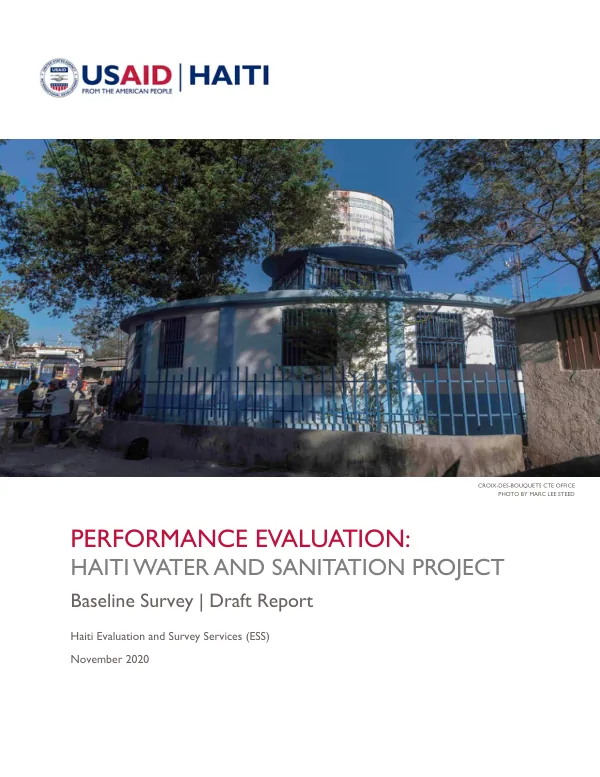
USAID/Haiti evaluations and survey services plus (ESS+) : water, sanitation, and hygiene (WASH) baseline survey : final report
Sign inIBI
The United States Agency for International Development (USAID) Haiti Mission commissioned a baseline survey measuring the status of access to and quality of basic drinking water and sanitation services, hygiene facilities, and open defecation (OD) practices and norms.
2023
Abstract
This survey took place in 20 communes across nine departments and a set of Port-au-Prince neighborhoods. The results of this study will be used to support data-driven decision-making for future USAID/Haiti WASH activities and provide a reference point for an endline evaluation. Due to safety concerns, the survey took place via two modalities: face to face in 19 accessible communes (those other than Croix-desBouquets and Port-au-Prince) and via cell phone (in Croix-des-Bouquets and Port-au-Prince). Using USAID definitions of basic water and sanitation services, 37.7 percent of households surveyed in the accessible communes and 13.1 percent of households surveyed in Croix-des-Bouquets and Port-auPrince had access to basic drinking water services. Furthermore, 35.6 percent of households in the accessible communes had access to basic sanitation services, compared to 70.0 percent of households surveyed in Croix-des-Bouquets and Port-au-Prince. The report goes into further detail on indicators of water and sanitation service quality, such as water accessibility, reliability, safety, and affordability and excreta containment and disposal services. The survey also collected information on hygiene facility availability and OD. In the accessible communes, three out of ten households did not have soap or water available to wash their hands. Hygiene facility availability was not examined in Croix-des-Bouquets or Port-au-Prince. In the accessible communes, 42.3 percent of respondents reported seeing a child openly defecate, compared to 23.8 percent in Croix-des-Bouquets and Portau-Prince; and 33.1 percent in the accessible communes saw an adult openly defecate, compared to 17.7 percent in Croix-des-Bouquets and Port-au-Prince. Despite this, close to all respondents in all areas reported that OD, by a child or adult, was not acceptable. The report also discusses household characteristics associated with access to basic water and sanitation services and OD practices. These findings provide critical conclusions and recommendations that can be used in planning for, designing, and evaluating future WASH activities in Haiti.
Connected topics
Classification
![Emergency food security program in La Gonave, Haiti : USAID - emergency food security program (EFSP) : final report [baseline]](https://covers.devme.ai/gen/1125.webp)