USAID DEC
USAID Harmonia Activity: Communities Ending Gender-Based Violence Quarterly Report January-March 2021
Sign inHEALTH ALLIANCE INTERNATIONAL
USAID Harmonia Activity: Communities Ending Gender-Based Violence Quarterly Report January-March 2021
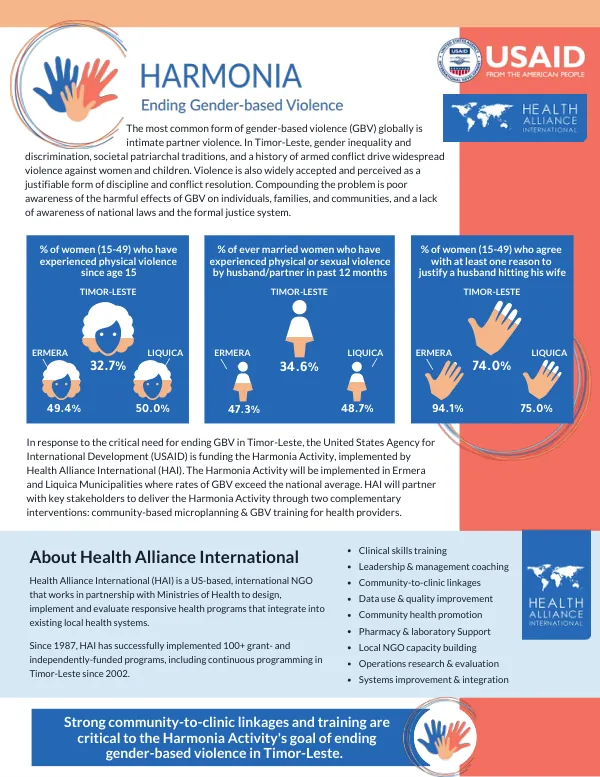
The USAID Harmonia Activity, Communities Ending Gender-Based Violence, aims to end GBV in communities by applying a people-to-people approach, working towards more equitable gender relations and improved gender-sensitive health services for women in Timor-Leste.
2021 · 20 pages
Sign in to readA free account is required to download.
Abstract
The activity focuses on 31 sucos and 10 health centers in Ermera and Liquica municipalities, with a three-year duration starting from August 2020. Key partners for the activity include the Ministry of Health (MoH), National Institute for Health (INS), Ministry of Social Solidarity and Inclusion (MSSI), and Secretary of State for Equality and Inclusion (SEII). The community activities will emphasize increasing knowledge and awareness and shifting attitudes and social norms regarding GBV in communities and in health settings. Community action plans will be developed by village leadership to address specific GBV-related issues, followed by information and learning sessions with the general community. The health sector intervention will provide intensive and follow-up training on responding to GBV, aiming to enhance the ability of health providers to properly support clients experiencing GBV. The Harmonia team has developed various ways of assessing and mitigating challenges experienced during the first quarter, including facilitating development and approval of the Responding to GBV Learning Lab curriculum and adjusting implementation of the baseline survey. Quarter 3 (April, May, June 2021) will see scaling up of activity implementation, with community microplanning (CMP) action planning, administrative post advocacy meetings, and the commencement of information and learning sessions. The Responding to GBV curriculum will have been approved, and the Training of Trainer (ToT) will be held, with the health provider training already begun. The baseline survey analysis will have been completed and can be used to inform information and learning sessions in communities. The Harmonia team will be engaged in review and reflection activities to ensure adherence to the Do No Harm principle and to identify challenging areas of practice and areas for improvement. The activity expects to reach seven milestones during the next quarter, including the approval of the Responding to GBV Learning Lab curriculum, municipal advocacy meetings, microplanning sessions, and GBV trainings. The ongoing imposition of the sanitary fence in Dili, Ermera, and Liquica has complicated travel and may impact the achievement of upcoming milestones. However, the Harmonia team has made progress in developing ways to assess and mitigate challenges, and the activity is on track to achieve most of the upcoming milestones. The Harmonia Activity has continued to develop plans and reports, with most now approved by USAID and uploaded to the Development Experience Clearinghouse (DEC). The USAID Harmonia Gender Equality and Social Inclusion (GESI) Analysis has been published on email list serve ETAN, posted on the HAI web page, and emailed and hand-delivered to relevant partners in Timor-Leste. The Harmonia team has made adjustments to the MEL Plan based on further review of targets and indicators, and the updated plan is currently being reviewed by USAID. The activity has also made progress in developing the Responding to GBV Learning Lab curriculum, with the structure of the draft currently being edited in consultation with INS staff. The Harmonia team has identified ways of facilitating development and approval of the curriculum, in accordance with the content and structure identified by INS and the MoH. The baseline survey analysis is underway, and the data will be used to inform information and learning sessions in communities. The Harmonia Activity has also engaged in stakeholder engagement, particularly at the municipality level, and has held a joint activity launch with USAID Healthy Relationships for a Violence-Free Future. The activity has also contributed to the Guiding Principles and Special Considerations on Implementation Approaches, and has identified challenges and delays in the implementation of the activity.