HUMANITY AND INCLUSION
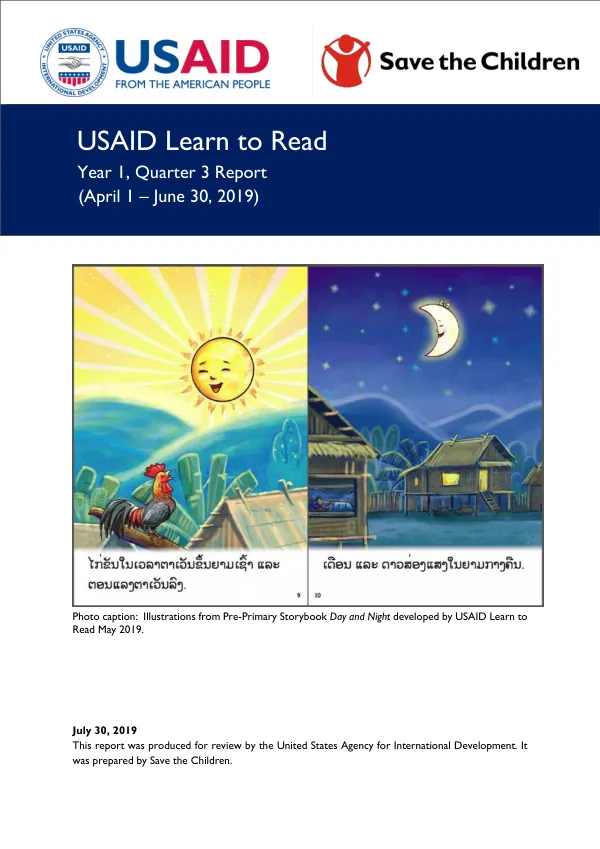
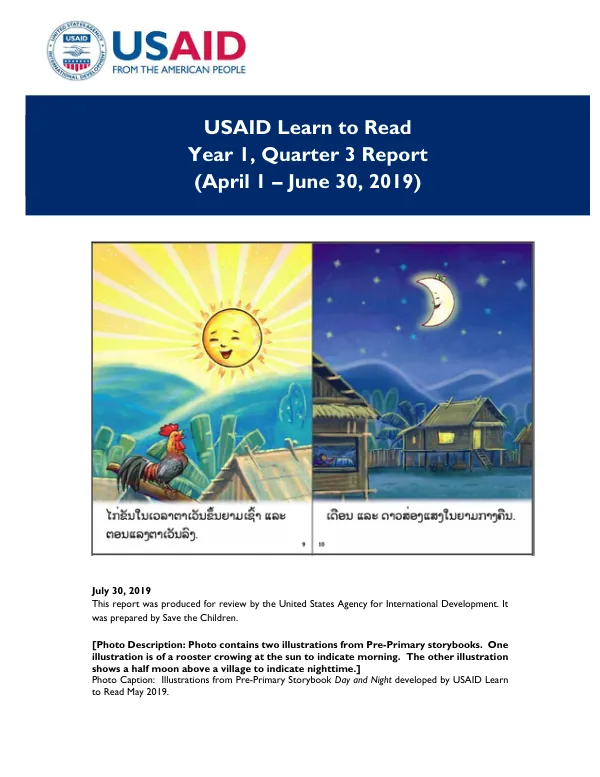
USAID Learn to Read Year 1, Quarter 3 Report (April 1 – June 30, 2019)
The USAID Learn to Read Activity is a five-year project implemented by a consortium led by Save the Children, in partnership with Room to Read and Humanity & Inclusion.
2019 · 48 pages
Sign in to readA free account is required to download.
Abstract
The project aims to improve the reading skills of children in Pre-Primary, grade 1, and grade 2 classes in Lao People's Democratic Republic (Lao PDR), with a focus on non-Lao-speaking children and children with disabilities. The project works closely with the Ministry of Education and Sports (MOES) and development partners to strengthen the Lao education system with evidence-based approaches. The project has a flexible, system-strengthening approach to addressing key gaps that limit reading skill acquisition. It emphasizes MOES ownership and reinforces government and non-government national, provincial, and local-level systems through co-design and co-implementation. The project is being implemented in close coordination and partnership with the MOES and with leading donor-funded education initiatives to ensure that the systems-strengthening, school improvement, and community mobilization efforts are complementary and mutually reinforcing. The project has partnered with Global Partnership for Education (GPE II) to support the MOES Research Institute for Educational Sciences (RIES) to develop a Reading Readiness (RR) and instructional materials package for Pre-Primary. In Year 1, GPE II, RIES, and the Activity are working to jointly develop one program for reading readiness in collaboration with other development partners through the newly established RR Task Team. The project is working closely with UNICEF and the MOES Early Childhood Education (ECE) department to ensure alignment of the PP-RR program with the national education sector development plan. The project has a Strategic Opportunities Fund (SOF) available to provide flexibility in responding to unanticipated gaps, needs, and opportunities such as expanding into new languages, new locations, or alternative media such as community radio. The project aims to reach an estimated minimum of 65,313 children over the life of the project, with school and community-level activities taking place in 16 districts in four provinces of Lao PDR. The project's goal is to improve reading skills for all children in Pre-Primary, grade 1, and grade 2, with a focus on the inclusion of non-Lao-speaking children and children with disabilities. The project will develop and distribute teaching and learning materials, train and support teachers, and engage school communities to help children to learn to read on time. The project's approach emphasizes MOES ownership and reinforces government and non-government national, provincial, and local-level systems through co-design and co-implementation. The project has made significant progress in Year 1, Quarter 3, with key accomplishments including the development of a Reading Readiness (RR) and instructional materials package for Pre-Primary, the establishment of a RR Task Team, and the initiation of school and community-level activities in 16 districts in four provinces of Lao PDR. The project has also made progress in building capacity to scale up and maintain the interventions in future, with a focus on MOES ownership and reinforcement of government and non-government national, provincial, and local-level systems. The project's monitoring, evaluation, and learning (MEL) system is being implemented to track progress and identify areas for improvement. The MEL system includes a range of indicators and data collection tools to monitor project performance and impact. The project's management and administration team is responsible for ensuring the effective implementation of the project, including the management of finances, human resources, and logistics. The project has encountered several challenges, including the need to adapt to changing circumstances and priorities, the need to build capacity and ownership among MOES and other stakeholders, and the need to ensure the sustainability of project interventions. The project's future directions and upcoming activities include the continuation of school and community-level activities, the expansion of the project to new locations and languages, and the development of new teaching and learning materials and instructional approaches. The project's updated MEL data indicates that significant progress has been made in Year 1, Quarter 3, with key indicators including the number of children reached, the number of teachers trained, and the number of teaching and learning materials developed and distributed. The project's success story highlights the impact of the project on the lives of children and communities in Lao PDR, with a focus on the inclusion of non-Lao-speaking children and children with disabilities.
Related documents