CENTER FOR EDUCATIONAL DEVELOPMENT
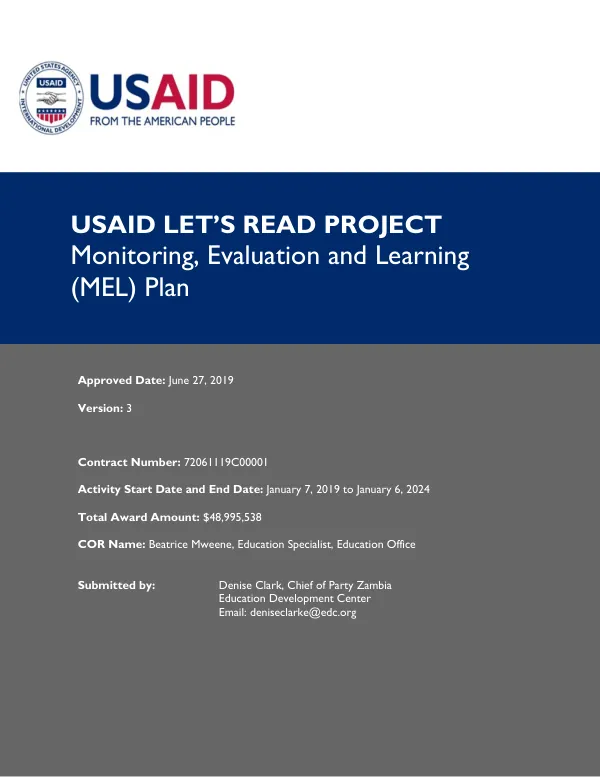
USAID Let's Read Project Monitoring, Evaluation and Learning (MEL) Plan
The USAID Let's Read project aims to improve reading outcomes for approximately 1.4 million children attending public and community schools in Zambia.
2019 · 31 pages
Sign in to readA free account is required to download.
Abstract
The project is aligned with Goal One of the USAID Global Education Strategy, which seeks to improve reading levels for a hundred million primary-school learners. The activity directly supports the USAID/Zambia 2011-2018 CDCS Development Objective (DO) No. 3, 'Human Capital Improved,' and under that DO, the Intermediate Result (IR) "Educational Achievement in Math and Reading Improved." The project targets five provinces in Zambia, including Eastern, Muchinga, Southern, Northwestern, and Western, where there are approximately 4,250 public and community primary schools. The project's main objectives are to ensure that pre-primary pupils develop oral language skills and emergent literacy skills in one of the seven official local languages, and that Grades 1-3 pupils learn to read with fluency, comprehension, and write at grade-level in one of the seven local official languages of instruction. The project's Development Hypothesis holds that if time spent on reading instruction is sufficient, if children are taught to read in a language that they speak and understand, if there are relevant teaching and learning materials in the seven local languages, if teachers are well-trained, mentored, and coached to teach and formatively assess reading acquisition in local languages using the appropriate approaches, if the education system is equipped to test early grade reading skills and report and analyze results, and if families and communities are involved in the education of their children, then early grade pupils will be able to read with fluency and comprehension at grade level. The project will ensure that pre-primary pupils in the targeted provinces develop oral language skills and emergent literacy skills in one of the seven official local languages to prepare them for successful transition to Grade 1. Grades 1-3 pupils in the target provinces within public and community schools will learn to read with fluency, comprehension, and write at grade-level in one of the seven local official languages of instruction. The project's implementation will be challenging due to the demands on teachers and in-service support personnel at the zonal and district levels, as well as the notable differences in school contexts by region, language, and type of school. However, contextualizing and tailoring the basic PLP approach to the needs of individual schools would provide more solid support for implementation. The project's monitoring, evaluation, and learning (MEL) plan will be critical in ensuring that the project's objectives are met and that the project's impact is maximized. The MEL plan will include indicators and targets that will be used to measure the project's progress and impact. The project's performance tracking system will also be critical in ensuring that the project's objectives are met and that the project's impact is maximized. The project's implementation will be led by the Education Development Center, with the support of the Ministry of General Education and other stakeholders. The project's budget is $48,995,538, and the project's duration is from January 7, 2019, to January 6, 2024.