USAID DEC
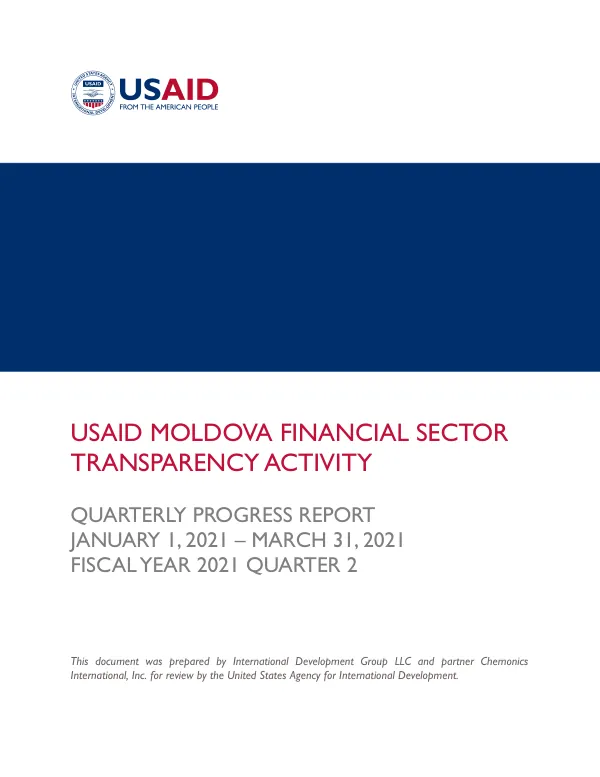
USAID Moldova Financial Sector Transparency Activity Quarterly Progress Report FY21 Q2
Sign inCHEMONICS
USAID Moldova Financial Sector Transparency Activity Quarterly Progress Report FY21 Q2
The USAID Moldova Financial Sector Transparency Activity (FSTA) aims to support economic growth through improving the financial sector transparency, stability, and soundness in Moldova.
2021 · 27 pages
Sign in to readA free account is required to download.
Abstract
The goal of FSTA is to strengthen the capacity of the National Bank of Moldova (NBM), the Moldova Central Securities Depository (CSD), and the Moldova National Commission for Financial Markets (NCFM) to combat financial crimes, automate the monitoring of shareholder transparency, and fight systemic money laundering in the banking sector. FSTA has four major components: (1) Strengthen the capacity of the GOM and NBM to combat financial crime, (2) Capacity Building and support for the CSD of Moldova, (3) Capacity Building and support for the NCFM of Moldova, and (4) Assist the GOM in improving its Fiscal/Budgetary transparency. The FSTA contract was signed on September 5, 2019, with an official start date of September 9, 2019. The contract period of performance was extended in February 2021, changing the end date from September 8, 2022 to May 8, 2023 at no additional cost. During the reporting period, a major milestone was completed: the contract signing for the implementation of the NBM AML Software Solution. The initial planning meetings took place in late March, while the formal project kick-off involving all stakeholders is scheduled for April 7, 2021. FSTA also finalized the strategy document containing an AML/CFT roadmap and recommendations for the NBM, and developed two documents to support the NBM in the software implementation phase. In addition, FSTA organized a two-day AML/CFT workshop for the Moldova Post Office, providers of payment services, e-money issuers, and a few intermediary banks in the area of funds transfers. FSTA also finalized the Concept paper on the retail platform for government securities and other financial instruments and published the paper for public discussion. Furthermore, FSTA continued to develop the Terms of Reference encompassing technical specifications for the retail market platform for government securities. FSTA also conducted a gap analysis addressing three components of CSD's activity: regulatory, legal and tax, and technical infrastructure. The gap analysis will be used to assess CSD's viability to join European Union (EU) Financial Action Task Force (FATF) depositories. FSTA researched and formulated proposals regarding relevant associations the CSD could join as an intermediate step before establishing an interconnection with an EU depository. FSTA built capacity of insurance companies through a series of workshops on risk management and developed an additional report on the insurance of the Hazardous Industrial Objects, offering specific amendments that should be considered in the new draft law. FSTA also developed a comprehensive communication strategy to raise the visibility of USAID assistance aimed at enhancing the Moldovan financial sector and to support FSTA's beneficiary institutions to better communicate with their audiences. The following sections present a summary of activities undertaken during the reporting period. FSTA received USAID CO and CIO approval to sign the contract for the implementation of the NBM AML Software Solution. FSTA, IDG, and the NBM thoroughly reviewed the contracts submitted by SAS, including issues surrounding signatory parties, starting dates, licensing arrangements, etc. The review process took longer than anticipated, due to the large number of approvals required on behalf of the NBM. The contract and related supplements were signed in late March and the official planning meetings took place at the end of the quarter. FSTA will oversee all phases of the development, installation, and implementation of the NBM AML Software Solution over the next 25 months. The solution will enhance the NBM's ability to monitor and analyze financial transactions, identify potential money laundering and terrorist financing risks, and take enforcement actions against financial institutions that fail to comply with AML/CFT regulations. FSTA's efforts to strengthen the capacity of the GOM and NBM to combat financial crime are critical to improving the financial sector transparency, stability, and soundness in Moldova. By enhancing the NBM's ability to monitor and analyze financial transactions, FSTA will help to prevent money laundering and terrorist financing, and promote economic growth and stability in Moldova.