USAID DEC
USAID/Nepal evaluation report, FY 1982-6 : integrated nonformal education to promote rural development in Nepal
Sign inUSAID. MISSION TO NEPAL
USAID/Nepal evaluation report, FY 1982-6 : integrated nonformal education to promote rural development in Nepal
Evaluates pilot project to develop materials, methods, and training techniques in participatory integrated nonformal education (NFE) for use by Nepal's Ministry of Education (MOE).
Brennan, D. J. · 1982
Sign in to readA free account is required to download.
Abstract
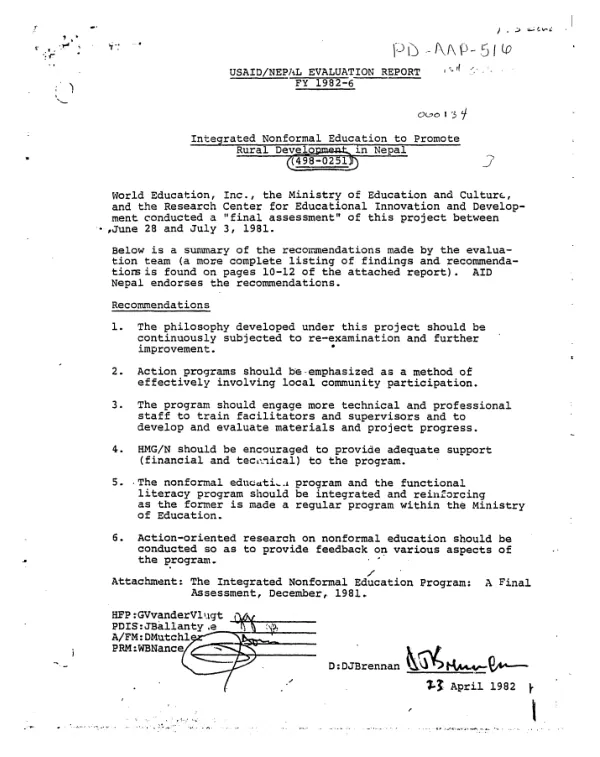
Final Mission evaluation covers the period 7/78-7/81 and is based on an attached final report (XD-AAP-516-A). Focusing on the individual decisionmaker, the project, one of the first education projects in Nepal to be guided by a defined philosophy, developed five interesting and nonthreatening learning approaches - motivational, analytical, creative, planning, and didactic. Experimental techniques such as games, puppets, and drawing were used, and group discussions were led by trained village facilitators. The project's emphasis on action programs proved effective, leading to attitudinal changes in villagers and to their participation in community activities (e.g., health, nutrition, agriculture). The project's relatively high cost was due not only to its pilot nature but also to the difficult logistics requirements. In the project's final year it was shifted by the Government of Nepal (GON) to the MOE as a first step toward integrating NFE with the already established functional literacy program. It is recommended that: (1) the project's philosophy be continuously re-examined and improved; (2) action-oriented learning programs be further emphasized; (3) technical and professional staff be hired to train facilitators and supervisors and to develop materials and evaluate project progress; (4) the GON be prepared to support NFE programs in areas noted under (3); and (5) research be conducted to provide feedback on program progress. The positive nature of the evaluation was instrumental in a USAID/N decision to fund a follow-on project with the MOE.
Related documents