USAID DEC
USAID/OTI Burkina Faso Regional Program Semi-Annual Report: October 1, 2019 – March 31, 2020
Sign inBEARING POINT, INC.
USAID/OTI Burkina Faso Regional Program Semi-Annual Report: October 1, 2019 – March 31, 2020
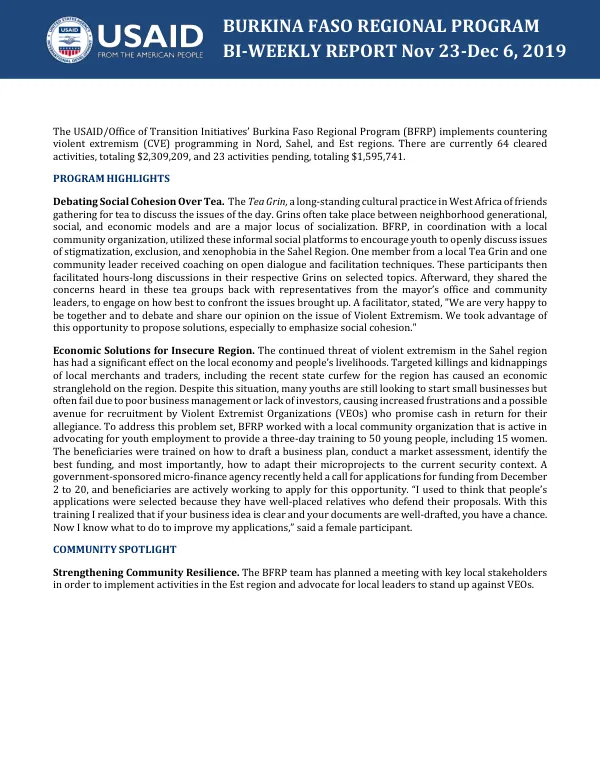
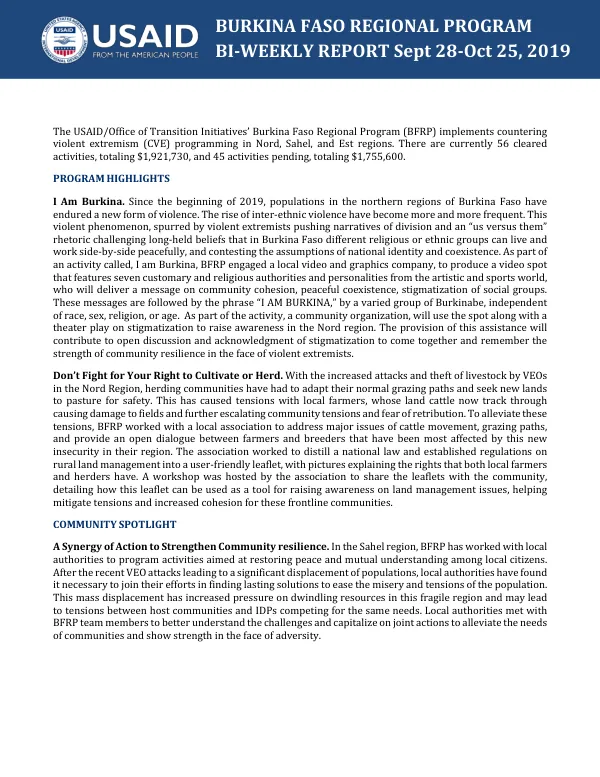
The Burkina Faso Regional Program (BFRP) implements countering violent extremism (CVE) programming in the Nord, Sahel, and Est regions of Burkina Faso.
2020 · 31 pages
Sign in to readA free account is required to download.
Abstract
The program targets a total of twenty-six communes, including eleven in the Sahel region, five in the Nord region, seven in the Est region, and three in the Centre-Est region. Four communes were placed on "hold" during the reporting period due to security and accessibility issues in the Sahel region, and activities in the Nord have been suspended due to security issues. BFRP's office in Fada N'Gourma implemented activities in four initial communes and will expand in seven other communes in the Est and Centre-Est region in the coming reporting period. The program held its first strategy review session (SRS) in October 2019 and revised its strategy to pursue two objectives: community level resilience and support to state efforts. Two main objectives and four clusters were defined for activities developed or implemented during this reporting period to strengthen community resilience to violent extremism. Key results during the reporting period include building on previous achievements and supporting trained leaders to initiate actions in their community. In the Sahel region, a forum was organized that encouraged thirty local leaders to discuss their viewpoints with the mayor on steps toward mitigating tension among community members and strengthening the stability of their commune. Trained leaders also facilitated the creation of a Local Council for Social Cohesion to further undertake initiatives at a local level. Economic workarounds were piloted, adapted, and shared in the Nord region, targeting two hundred vulnerable youth and women from several communes in the central Nord region. These trainings were accompanied by discussions on violent extremism and how best to counter recruitment efforts made by violent extremist organizations (VEOs) that exploit economic vulnerabilities. In the Sahel, five activities contributed to training and equipping over four hundred fifty people, including two hundred women, on entrepreneurship and how to identify adaptive business solutions in light of the growing insecurity. Traditional community resilience mechanisms were championed through soccer tournaments and radio shows in the target communes. About eighty trained community representatives participated in a set of radio shows in which women, youth, and religious leaders provided context, heard from local callers, and discussed the stigmatization and marginalization that is often exploited by extremists to sow division and fear. Soccer tournaments were organized in the Nord and Sahel regions, reaching well over five thousand community members across these activities. Activities to deliver public services, managed by local mayors, provide a means for government to show they have not abandoned these communities in these difficult times. For example, the program helped close to forty thousand community members across Est, Nord, and Sahel regions to receive birth certificates and/or national ID cards during campaigns coordinated at the national level with ONI (the national agency for ID cards) and local mayors' offices. BFRP also repaired nine water points, including four in the Nord region and five in the Sahel region, mitigating tensions over use of and access to natural resources between host and internally displaced persons (IDP) communities. The country context during this reporting period was marked by increasing insecurity and violent extremist activities in the Sahel region. The government of Burkina Faso has been working to address these challenges through a range of initiatives, including the deployment of security forces and the implementation of development programs aimed at addressing the root causes of extremism. BFRP's activities are designed to support these efforts by building community resilience and promoting social cohesion in the target regions. BFRP developed activities in partnership with thirty-five grantees, including civil society organizations, local authorities, and community organizations focused on the project goal of strengthening community resilience to violent extremism. The program's office in Fada N'Gourma implemented activities in four initial communes and will expand in seven other communes in the Est and Centre-Est region in the coming reporting period. The program's strategy refinement in October 2019 introduced a new cluster (Cluster 1.1) and a second objective (Objective 2: Reinforce the State's Capacity to Respond) that more accurately reflected programming priorities and opportunities.
Related documents