SAVE THE CHILDREN FUND
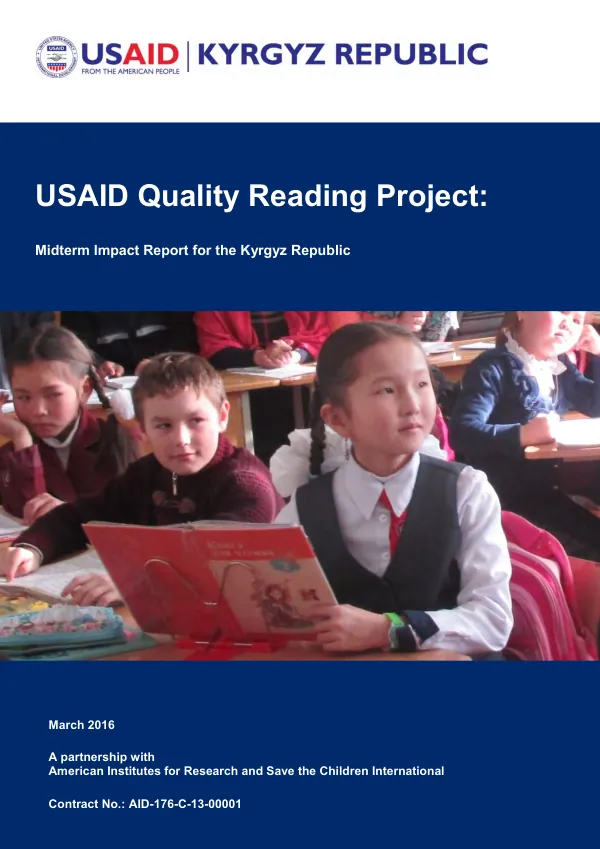
USAID Quality Reading Project: Midterm Impact Report for the Kyrgyz Republic
The USAID Quality Reading Project in the Kyrgyz Republic aimed to improve reading skills for primary grade students.
2016 · 54 pages
Sign in to readA free account is required to download.
Abstract
The project's main interventions included teacher training, mentoring, reading materials, out-of-school activities, and policy-level support. Teacher training was a key component, with a focus on improving instructional practices and increasing teacher confidence. The project's theory of change posits that improved teacher instructional practices will lead to better student reading outcomes. The literature review highlights the importance of early grade reading assessment (EGRA) in measuring reading skills and the need for effective teacher training to improve reading outcomes. The research design involved a randomized controlled trial, with 130 schools randomly assigned to treatment and control groups. Descriptive statistics show that the treatment group had a higher percentage of students with mothers who had completed secondary education, while the control group had a higher percentage of students with mothers who had completed primary education. The results of the midterm EGRA assessment indicate that beneficiary students in Grade 2 knew seven more words per minute than control students, and five more words per minute in Grade 4 than control students. Subgroup analysis reveals that the impacts on reading outcomes were consistent across different student subgroups, including boys and girls, students from urban and rural areas, and students from different language backgrounds. Longitudinal subsample results show that the impacts on reading outcomes were sustained over time, with beneficiary students continuing to outperform control students in Grade 4. The project's impact on intermediate outcomes, such as teaching practices and parent attitudes towards reading, was also significant. The results show that beneficiary teachers were more likely to use effective instructional practices, such as phonics and phonemic awareness, and that parents were more likely to engage in reading activities with their children. The project's impact on student reading at home and student participation in reading activities was also significant, with beneficiary students showing higher levels of engagement in reading activities. The limitations of the study include the potential for selection bias and the need for longer-term follow-up to assess the sustainability of the project's impacts. However, the results of the midterm impact report suggest that the USAID Quality Reading Project is having a positive impact on reading skills for primary grade students in the Kyrgyz Republic.