MINISTRY OF EDUCATION AND CULTURE
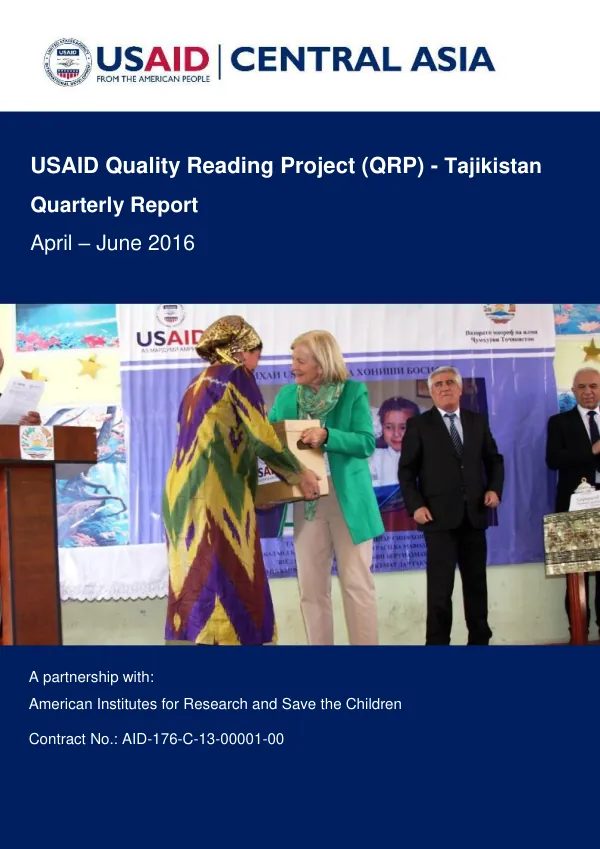
USAID Quality Reading Project – Tajikistan - Quarterly Report (April– June 2016)
The USAID Quality Reading Project (QRP) in Tajikistan is a four-year initiative implemented by the American Institutes for Research (AIR) and Save the Children (SC).
2016 · 57 pages
Sign in to readA free account is required to download.
Abstract
The primary objective of the project is to improve the reading and critical thinking skills of children in grades 1-4 through assistance to government ministries and school-based educators in Tajikistan and the Kyrgyz Republic. The project aims to improve reading skills among primary-grade students by drawing on existing structures in both countries, building capacity from the national level down to the classroom. The project has several additional goals, including establishing grade-level minimum standards for key early literacy skills, such as phonics and reading comprehension, and strengthening national systems to administer standardized and classroom-based assessments in order to track student learning and use data for decision-making. The project also aims to promote consistent data collection, analysis, and decision-making with local partners using an early grade reading assessment, bolster government efforts to strengthen teaching and learning in Tajik and Russian languages based on international standards and best practices, and inform and empower parents and community members on the importance of reading at home through media, parent-teacher collaboration, and support to school libraries. During the April-June 2016 quarter, the project conducted a training for District Education Department (DED) methodologists and representatives of Teacher Training Institutes (TTI) on competency-based standards. The training was held May 13-22 in the Dushanbe and Qurghonteppa TTI with 160 teachers, DED methodologists, and representatives of TTIs in attendance. The trainings included content from the In-Service Teacher Training (IST) package developed by the USAID Quality Reading Project and emphasized the crucial role of parents and family in supporting children's literacy in the home. The project also established summer reading camps in 80 project schools with close support of the Ministry of Education and Science (MOES). Reading camps are held weekly, after in-school activities have concluded, and teachers use a Reading Camp guide to lead children in a structured set of games and activities that enhance their reading skills. Trainings on the Reading Camp methodology and content training for librarians were also conducted in May, with over 1,100 librarians and teachers attending these trainings. Primary-grade teachers participated in a session on the "Reading Buddy" approach and used this method to support struggling readers in their classrooms by assigning an upper-grade student to read with them. Teachers acknowledged this as a valuable mechanism to support children who need extra help with reading. The 2016 Early Grade Reading Assessment (EGRA) and annual monitoring and evaluation (M&E) data collection was completed in April and May. The team is now working on data cleaning and analysis. Over 8,000 students were tested from 132 schools—66 control and 66 treatment schools. The project has made significant progress in achieving its objectives, including the training of 160 teachers, DED methodologists, and representatives of TTIs on competency-based standards, the establishment of summer reading camps in 80 project schools, and the training of over 1,100 librarians and teachers on the Reading Camp methodology. The project has also collected data from over 8,000 students through the EGRA and M&E assessments. The project's next quarter (July-September 2016) will focus on continuing the training of teachers, DED methodologists, and representatives of TTIs on competency-based standards, establishing summer reading camps in additional project schools, and conducting trainings on the Reading Camp methodology and content training for librarians. The project will also continue to collect data through the EGRA and M&E assessments and analyze the data to inform decision-making and program improvement.