USAID DEC
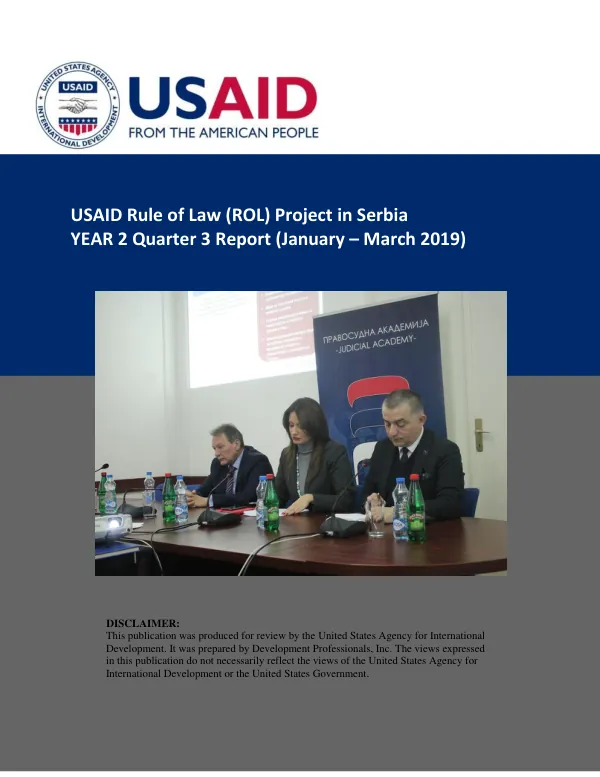
USAID Rule of Law (ROL) Project in Serbia Year 2 Quarter 3 Report (January – March 2019)
Sign inMINISTRY OF JUSTICE
USAID Rule of Law (ROL) Project in Serbia Year 2 Quarter 3 Report (January – March 2019)
The Rule of Law (ROL) Project in Serbia is a USAID-funded initiative aimed at advancing the rule of law in Serbia.
2019 · 24 pages
Sign in to readA free account is required to download.
Abstract
The project's primary objective is to strengthen the country's judicial system, improve access to justice, and enhance the efficiency of the justice sector. The project is implemented by Development Professionals, Inc. and is supported by the Ministry of Justice (MOJ) and other key stakeholders. The project's activities are focused on several key areas, including the development of a new National Judicial Development Strategy (NJDS) for the period 2019-2024. The first draft of the NJDS was presented to the MOJ-appointed working group and the international community in January 2019. The strategy aims to improve the efficiency and effectiveness of the judicial system, enhance access to justice, and promote the rule of law in Serbia. Another key area of focus is the implementation of the Case Management System (CMS) in the basic and higher courts. The CMS, also known as the AVP, is a case management system that aims to improve the efficiency and effectiveness of the judicial process. The system is being upgraded to include new modules for service of process and court fee processing/collection, which will result in significant time and cost savings for judges and other stakeholders. The project is also working to improve the efficiency of the Public Enforcement Officers (PEOs) and the State Attorney's Office (SAO). The PEOs are responsible for enforcing court judgments, and the project is providing technical and legal drafting support to the process of drafting amendments to the Law on Enforcement and Security. The SAO is responsible for representing the state in court, and the project is providing institutional developmental support and public relations capacity building to the SAO. In addition to these activities, the project is also working to improve access to justice and promote the rule of law in Serbia. The project is providing training and capacity building to judges, prosecutors, and other stakeholders, and is working to promote the use of alternative dispute resolution mechanisms, such as mediation and arbitration. The project's results for the quarter include the completion of the first draft of the NJDS, the implementation of the CMS in the basic and higher courts, and the completion of the Strategic Plan for the SAO. The project also achieved significant progress in terms of out-of-court settlements processed pursuant to the Settlement Guidelines, and the system-wide utilization of PIS (Judicial Information System). The project's performance indicators for the quarter include the number of out-of-court settlements processed, the number of PIS users, and the average time for enforcement of judgments by PEOs. The project's targets for the quarter were met or exceeded for seven of the ten performance indicators, with the remaining three indicators showing progress towards the targets. Overall, the Rule of Law Project in Serbia is making significant progress towards its goals of advancing the rule of law in Serbia. The project's activities are focused on strengthening the judicial system, improving access to justice, and promoting the rule of law in Serbia. The project's results for the quarter demonstrate the project's commitment to these goals and its ability to achieve significant progress in a short period of time. The project's activities are also focused on improving the efficiency and effectiveness of the justice sector. The project is working to implement the CMS in the basic and higher courts, which will result in significant time and cost savings for judges and other stakeholders. The project is also working to improve the efficiency of the PEOs and the SAO, which will result in improved access to justice and a more effective justice sector. The project's geographic focus is on the Republic of Serbia, with a particular emphasis on the judicial system and the justice sector. The project's timeframes are focused on the period 2019-2024, with a particular emphasis on the development of the new NJDS and the implementation of the CMS in the basic and higher courts. The project's recommendations for the next quarter include the completion of the NJDS, the implementation of the CMS in the basic and higher courts, and the completion of the Strategic Plan for the SAO. The project also recommends continued support for the PEOs and the SAO, as well as continued promotion of the use of alternative dispute resolution mechanisms, such as mediation and arbitration.