CIMMYT
USAID’s ADS 200 Continuous Learning and Adaptation (CLA) Program
The USAID's ADS 200 emphasizes the importance of continuous learning and adaptation in development programs.
2015 · 4 pages
Sign in to readA free account is required to download.
Abstract
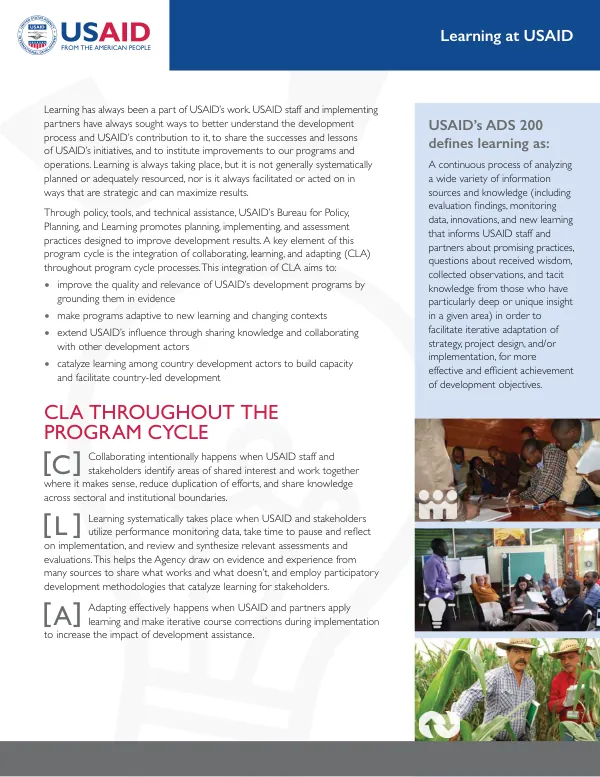
A continuous process of analyzing various information sources and knowledge informs USAID staff and stakeholders, facilitating iterative adaptation of programs. This process involves gathering insights from experts and stakeholders to improve the quality and relevance of USAID's development programs. The ADS 200 outlines four key objectives: to improve the quality and relevance of USAID's development programs by grounding them in evidence; to make programs adaptive to new learning and changing contexts; to catalyze learning among country development actors to build capacity and facilitate country-led development; and to facilitate CLA throughout the program cycle. CLA throughout the program cycle involves stakeholders identifying areas of shared interest and working together to achieve common goals. This process includes systematic learning, where USAID and stakeholders identify areas for improvement and work together to address them. Adapting effectively happens when USAID and partners apply learning and make iterative course corrections during implementation. The ADS 200 highlights several examples of CLA in action, including Guatemala, where USAID is working to reduce poverty and chronic malnutrition through systematic collaboration among stakeholders. In Malawi, USAID is leveraging early childhood education to improve reading skills among students. In Indonesia, USAID is working with the government to enable Indonesia to be a donor country. The ADS 200 also emphasizes the importance of learning resources, including the USAID Learning Lab, which is a collaborative platform where USAID staff and partners can share knowledge and best practices. The Learning Lab provides a space for knowledge sharing on how to implement effective learning approaches for missions and implementing partners. In addition, the ADS 200 highlights the importance of assessing missions' current CLA capacity, developing CLA plans, providing technical assistance and ongoing support, connecting missions, and connecting partners. The USAID Learning Lab is a key resource for facilitating CLA and promoting learning among USAID staff and partners. Overall, the USAID's ADS 200 emphasizes the importance of continuous learning and adaptation in development programs, and provides a framework for implementing CLA throughout the program cycle. By working together and sharing knowledge and best practices, USAID and its partners can improve the quality and relevance of development programs and achieve greater impact.