USAID DEC
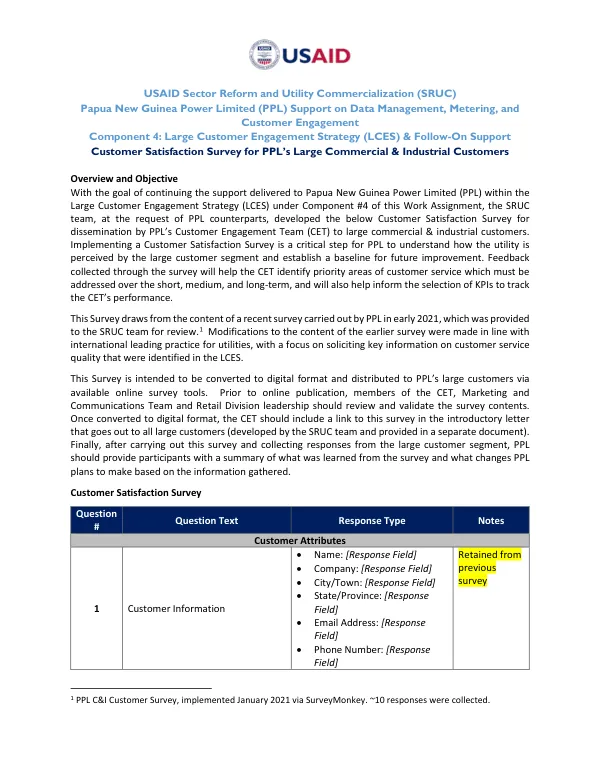
USAID Sector Reform and Utility Commercialization (SRUC) Papua New Guinea Power Limited (PPL) Support on Data Management, Metering, and Customer Engagement Component 4: Large Customer Engagement Strategy (LCES) & Follow-On Support Customer Satisfaction Survey for PPL’s Large Commercial & Industrial Customers
Sign inDELOITTE INC.
USAID Sector Reform and Utility Commercialization (SRUC) Papua New Guinea Power Limited (PPL) Support on Data Management, Metering, and Customer Engagement Component 4: Large Customer Engagement Strategy (LCES) & Follow-On Support Customer Satisfaction Survey for PPL’s Large Commercial & Industrial Customers
The Customer Satisfaction Survey for Papua New Guinea Power Limited's (PPL) large commercial and industrial customers was developed to understand how the utility is perceived by this customer segment and establish a baseline for future improvement.
2021 · 6 pages
Sign in to readA free account is required to download.
Abstract
The survey draws from a recent survey carried out by PPL in early 2021, with modifications made in line with international leading practice for utilities. The survey aims to solicit key information on customer service quality identified in the Large Customer Engagement Strategy (LCES). The survey consists of 24 questions, categorized into four sections: Customer Attributes, Perception of PPL Service (General), Perception of PPL Service (Customer Support), and Perception of PPL Service (Billing and Communications). The survey questions cover topics such as customer information, power usage, service interruptions, customer satisfaction, and communication preferences. The survey also includes questions on the advantages of being connected to PPL, customer support, billing procedures, and communications. The survey is intended to be converted to a digital format and distributed to PPL's large customers via online survey tools. Prior to online publication, members of the Customer Engagement Team, Marketing and Communications Team, and Retail Division leadership should review and validate the survey contents. Once converted to digital format, the Customer Engagement Team should include a link to the survey in the introductory letter that goes out to all large customers. The survey results will help PPL understand the needs and expectations of its large commercial and industrial customers, identify priority areas of customer service that must be addressed, and inform the selection of Key Performance Indicators (KPIs) to track the Customer Engagement Team's performance. The survey will also provide a baseline for future improvement and help PPL establish a customer-centric approach to its operations. The survey questions are designed to gather information on various aspects of PPL's service, including reliability, quality, customer support, billing procedures, and communications. The survey also includes questions on customer preferences for receiving non-emergency and emergency communications from PPL. The results of the survey will provide valuable insights for PPL to improve its service and enhance customer satisfaction. PPL's large commercial and industrial customers are the primary focus of this survey. The survey aims to understand their needs, expectations, and preferences regarding PPL's service. The results of the survey will help PPL tailor its services to meet the needs of its customers and improve overall customer satisfaction. The survey questions are designed to be clear and concise, with response options that allow customers to provide feedback on various aspects of PPL's service. The survey also includes questions on customer preferences for receiving non-emergency and emergency communications from PPL. The results of the survey will provide valuable insights for PPL to improve its service and enhance customer satisfaction. The survey results will be used to identify areas for improvement and inform the development of strategies to enhance customer satisfaction. The results will also be used to track the performance of the Customer Engagement Team and inform the selection of KPIs to measure customer satisfaction.
Related documents
Documents in this collection
 2021
2021USAID DEC
USAID Sector Reform and Utility Commercialization (SRUC) Task Order Papua New Guinea Power Limited (PPL) Support on Data Management, Metering, and Customer Engagement – Component 4: Large Customer Engagement Strategy (LCES)
Open record 2021
2021USAID DEC