USAID DEC
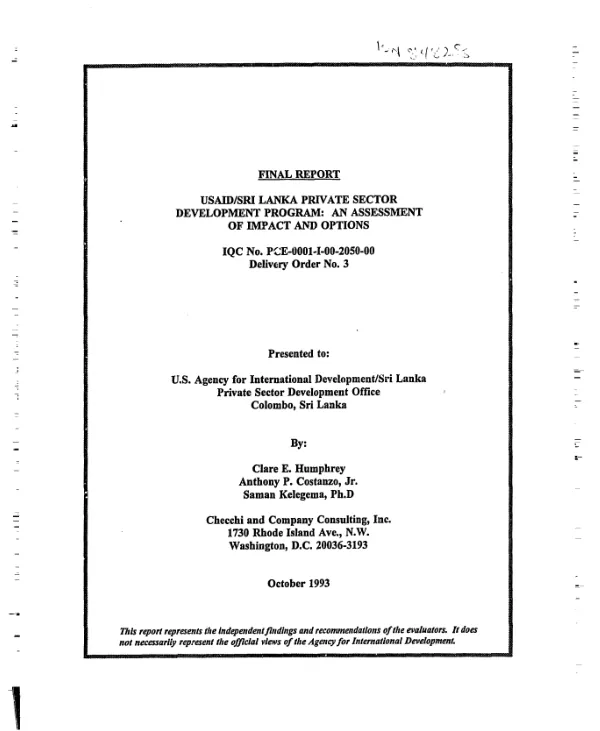
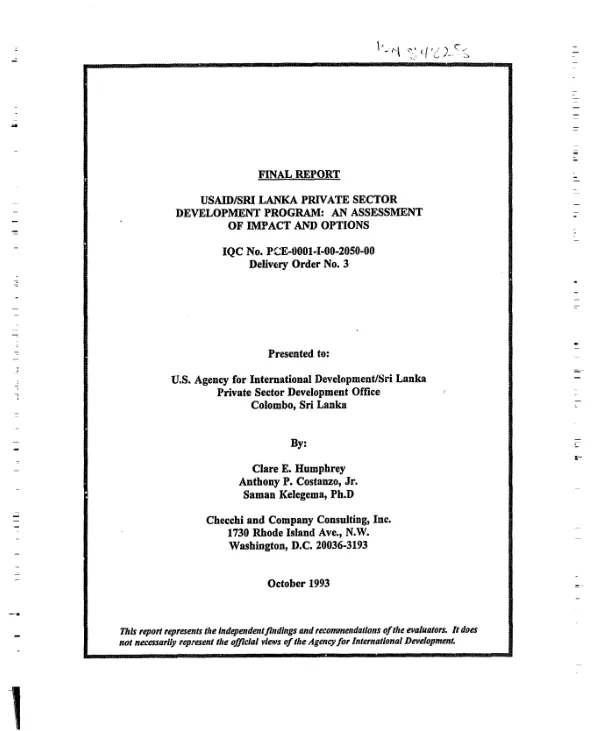
USAID/Sri Lanka private sector development program : an assessment of impact and options
Sign inCHECCHI AND CO. CONSULTING, INC. (CCCI)
USAID/Sri Lanka private sector development program : an assessment of impact and options
Evaluates the impact of private sector development programs implemented by USAID/Sri Lanka since 1983; 11 major projects and programs are given full analysis, while briefer attention is paid to several related programs.
Humphrey, Clare E.; Costanzo, Anthony P., Jr. +1 more · 1993
Sign in to readA free account is required to download.
Abstract
The consensus is that USAID/SL has designed and implemented a sound and well-balanced private sector program, in consonance with the Government of Sri Lanka"s (GSL"s) dramatic 1977 policy shift toward a market economy and well-suited to the needs and maturation patterns of the country"s business community. The greatest impact may have been qualitative, i.e., in helping to create an atmosphere conducive to progress and increasing the general competitiveness and skills of Sri Lankan businesses. Most USAID/SL programs have been designed and carried out in-house, although there has been effective use of some central and regional A.I.D. programs. The Mission has benefited from the experience and talents of its professional staff, and also from its association with an energetic reform-minded cadre of government and private sector leaders. Unlike many donors, USAID/SL is comfortable and effective working directly with private businesses and entrepreneurs. The Mission has succeeded at both the institutional/sectoral level and the firm level. For example, the Private Sector Policy Support (PSPS) project contributed substantially to strengthening leading chambers of commerce and improving dialogue between business and government; it also helped launch the Security Exchange Commission, strengthened the Colombo Stock Exchange, and created Sri Lanka"s first truly private venture capital company, as well as a merchant bank. In addition, various Mission programs have supported GSL legal and regulatory reform. USAID/SL also underwrote the GSL"s extremely successful public awareness campaign to rouse support for privatization, and when lack of transparency threatened popular support, the Mission was crucial in helping to reform the process. At the individual enterprise level, the Technology Initiative for the Private sector Project (TIPS), which collaborated with the highly successful IESC Volunteer Executive Program, clearly showed the business community the advantages of using improved technology to increase international competitiveness and also assisted individual firms with planning and modernization. While TIPS focused on large companies in Colombo, at the other end of the spectrum the Mahaweli Enterprise Development Project helped establish hundreds of small and medium agribusinesses, creating over 7,000 jobs; prospects for sustainability are very good. The PVO Co-financing program also supported numerous income-generating activities among disadvantaged groups, especially in rural areas. The increasing sophistication and effectiveness of USAID/SL"s program has come about because the Mission builds on its lessons learned. For example, the overly ambitious Private Enterprise Promotion Project led to the better organized and more effective PSPS. It is for such reasons that the Mission is recognized as the leader among the donor community promoting private sector development in Sri Lanka. USAID/SL"s experience teaches several lessons, among them: (1) direct assistance to the private sector is most effective when demand-driven; (2) the hands-off policy of both the GSL and the Mission in regard to transaction oriented program operations has paid off handsomely; and (3) projects that were not deliberately targeted, were prematurely ambitious, or were unfocused organizationally and programmatically were less successful. The evaluation team recommends that more attention be paid to the following issues/concerns: ensuring sustainability after USAID support ends; meeting the needs of small and medium businesses in provincial business centers; promoting further GSL disengagement from the economic arena; and addressing continuing constraints in the policy and legal environments. Within these contexts, future programs should focus on five areas: human resources development, capital generation, macroeconomic policy reform, legal and regulatory reform, and enterprise development.