USAID DEC
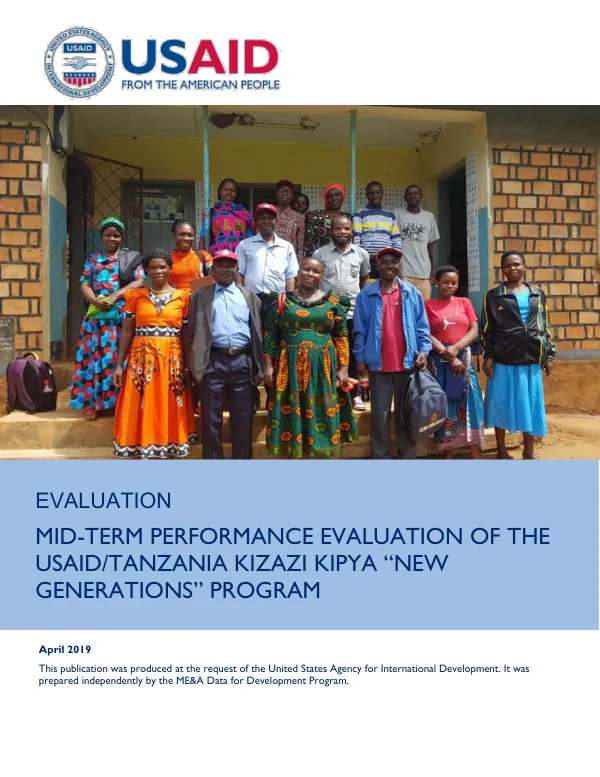
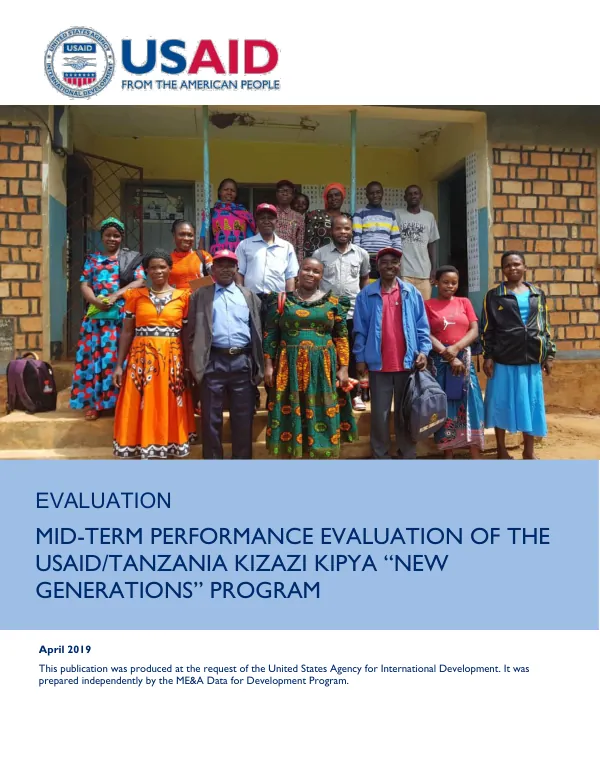
USAID/Tanzania mid-term performance evaluation of the kizazi kipya “new generations” project
Sign inME&A
USAID/Tanzania mid-term performance evaluation of the kizazi kipya “new generations” project
The USAID Data for Development Project (Data for Development) conducted a mid-term performance evaluation of the Kizazi Kipya Project implemented by Pact and its sub-grantees.
Beney, Terence; Laden, Jacob +2 more · 2019
Sign in to readA free account is required to download.
Abstract
The project’s goal is to improve the well-being of one million HIV-affected orphans and vulnerable children (OVC) and their families. Key expected results include improved health, nutrition, education, protection, livelihoods and psychosocial outcomes, as well as strengthening the HIV continuum of care among HIV positive OVC, youth, and their families. The evaluation’s purpose is to assess project performance, analyze the effectiveness of its approaches, assess its prospects for sustainability, and help the Mission to identify best practices and lessons learned. The project helped strengthen the national case management system and contributed to the continuum of care for HIV positive children and adolescents; however, there remains a need to optimize the referral to care and treatment system and scale-up services to support treatment adherence and viral suppression. The project contributed to household resilience and women’s empowerment through WORTH+ savings and loan groups, which show promising sustainability. Violence against children prevention and parent/guardian training contributed to changing caregiver behaviors towards children. Conversely, challenges remain in victim response and resolution of gender-based violence cases. Case management improved access to services: addressing service delivery needs locally, increasing the frequency of client referrals to services, and smoothing the referral process. However, challenges remain to the implementation and sustainability of the community volunteer approach. Ongoing donor commitments and increased government commitment are needed to bring the national case management system to scale and sustain it after project completion.
Related documents