SOCIAL IMPACT, INC.
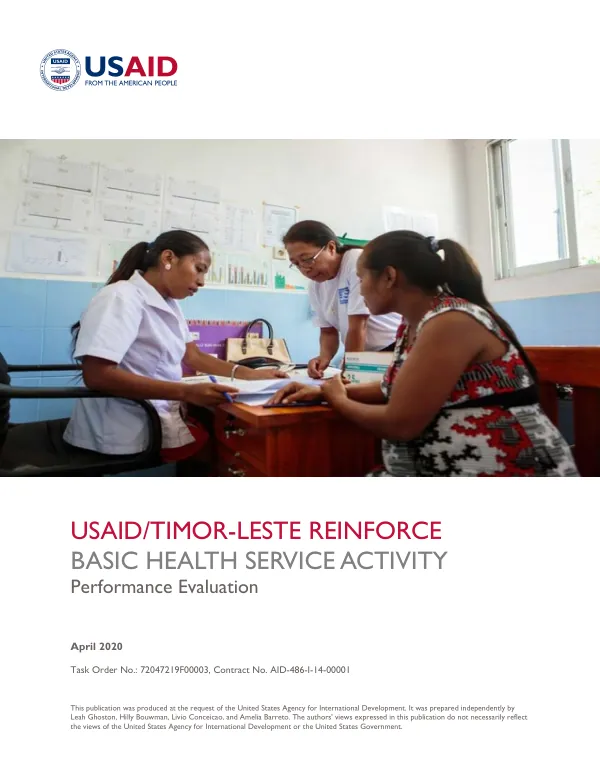
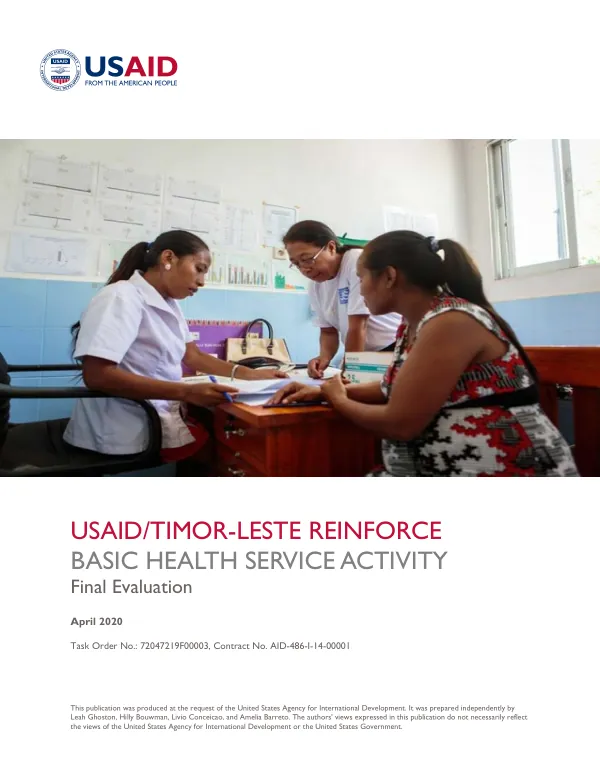
USAID/Timor-Leste reinforce basic health service activity : final evaluation
In 2015, the United States Agency for International Development (USAID) awarded the Reinforce Basic Health Services activity to John Snow, Inc., Research & Training Institute (JSI).
2020
Sign in to readA free account is required to download.
Abstract
The activity supports the Ministry of Health in Timor-Leste by improving health service delivery and promoting healthy behaviors for family planning and maternal and child health in Covalima municipality. USAID/Timor-Leste contracted Social Impact, Inc. (SI), to evaluate activity effectiveness, document promising practices, identify bottlenecks, evaluate the capacity and commitment of stakeholders, including the Ministry of Health (MOH), Municipality Health Service (MHS), and National Health Institute (INS), to institutionalize good practices, and to provide recommendations to guide future investments in public health. The evaluation team used a mixed methods approach, including a document review, key informant interviews, focus group discussions, a mini survey, and review of secondary data, to identify findings to address USAID’s evaluation questions. The evaluation found that Reinforce succeeded in engaging with and building the capacity of MHS and health facilities to adhere to service standards. However, the activity’s progress was limited by longstanding systemic governmental challenges in human resources, equipment, and infrastructure. Initiatives to support INS’s training capacity, improve MOH and MHS Covalima’s data management knowledge and quality, and improve health seeking behaviors and health outcomes for maternal, neonatal, and child health (MNCH) were successful in many ways, but faced strong obstacles to sustainability. Poor knowledge management, weak coordination, and a lack of transparency and consistency in budget allocation between the national and municipal levels prevents institutionalization of the best practices in Covalima. Replicating the model will rely on coordination among multiple government departments and partners seeking to support them. The report makes several recommendations to key stakeholders for future investment in human resources, sustainable and transparent financing, and improved system coordination.