USAID DEC
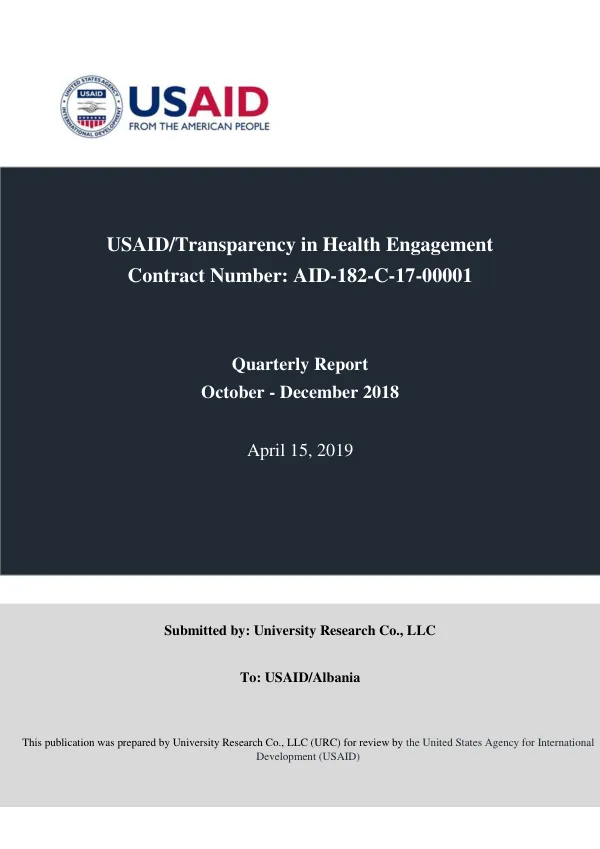
USAID | Transparency in Health Engagement Activity Quarterly Report January - March 2019
Sign inEUROPEAN UNION
USAID | Transparency in Health Engagement Activity Quarterly Report January - March 2019
The Transparency in Health Engagement Project aims to create a more accountable healthcare environment in Albania by promoting transparency and accountability between the government and its citizens.
2019 · 39 pages
Sign in to readA free account is required to download.
Abstract
The project envisions transparency in the health sector as a key feature of strong governance and a critical prerequisite for accountability. To address corruption issues in the health sector, the project is engaged in activities to build the capacity of the High State Audit (HSA), the High Inspectorate for the Declaration and Audit of Assets and the Prevention of Conflicts of Interest (HIDAACI), and the Ombudsperson Office to generate evidence through performance audits, complaints investigation, and asset reporting for sustainable transparency and accountability. The project is also working with civil society and media organizations to engage citizens to use their on-the-ground knowledge of corruption and problem solve on possible systems improvements. The project's goal is to create a more accountable healthcare environment that includes engaged beneficiaries and regular checks by appropriate authorities. During the fourth quarter period of Year 2, from January 1 through March 31, 2019, the project achieved several major milestones. The Electronic Asset and Conflict of Interest Declaration System (EACIDS) underwent a second phase of system users, which was conducted in February for all HIDAACI staff. Additionally, the project started the Users Acceptance Test for the system, organized a National Roundtable with the Office of the Ombudsperson on Best practices of collaboration with the Civil Society organizations, and provided assistance to the office of the Ombudsman for the Mobile App rollout strategy in four regional offices of the Ombudsperson. The project also finalized the Complains Mechanism for the Ombudsperson and prepared for the EACIDS launch event in collaboration with the COE and EU Delegation. However, the project faced several challenges, including the delayed procurement and installation of the EACIDS hardware by the Council of Europe (CoE), which resulted in further delays in the final installation and testing of the EACIDS system. The project worked with the local EACIDS vendor to revise the project plan to accommodate these delays and modified the purchase order in the reporting quarter to accommodate the revised activities. The project also faced delays in the final installation and the Training of HIDAACI users, with the delivery date of the project subcontractor postponed to mid-April. Albania has experienced many types of corruption in its history, exacerbated by weak governance systems and numerous political challenges. Transparency International (TI) ranks Albania as one of the most corrupt countries in Europe, with a drop in the score from 39 to 38 between 2016 and 2017. Albania's overall ranking within the 180 countries surveyed dropped from 83 in 2016 to 91 in 2017. A 2016 Trust in Governance Opinion Poll found that 48% of Albanians polled do not trust the healthcare system, and the TI Corruption Barometer of 2013 shows that 80% of Albanians believe informal payments are necessary to receive adequate quality healthcare in government facilities. The project's activities aim to address these corruption issues and promote transparency and accountability in the health sector. The project's work with the HSA, HIDAACI, and the Ombudsperson Office is focused on building their capacity to generate evidence through performance audits, complaints investigation, and asset reporting. The project's work with civil society and media organizations aims to engage citizens to use their on-the-ground knowledge of corruption and problem solve on possible systems improvements. The project's achievements during the fourth quarter period of Year 2 demonstrate its commitment to promoting transparency and accountability in the health sector. However, the project's challenges highlight the need for continued support and collaboration with stakeholders to overcome these obstacles and achieve its goals.