USAID DEC
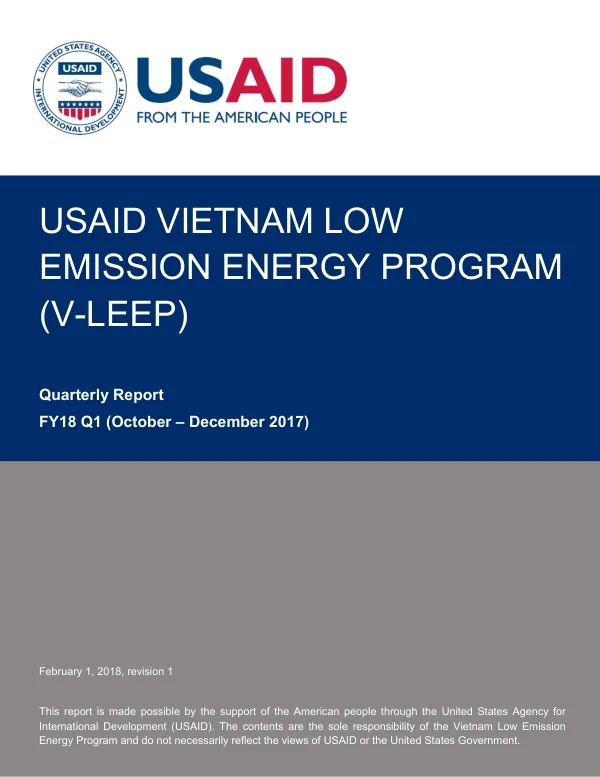
USAID Vietnam Low Emission Energy Program (V-LEEP) Quarterly Report FY18 Q1 (October – December 2017)
Sign inGOVERNMENT OF VIETNAM
USAID Vietnam Low Emission Energy Program (V-LEEP) Quarterly Report FY18 Q1 (October – December 2017)
The Vietnam Low Emission Energy Program (V-LEEP) began implementing its approved FY18 Year 3 Work Plan during the first quarter of the performance year.
2018 · 28 pages
Sign in to readA free account is required to download.
Abstract
The program also initiated consultations with its newly appointed government counterparts within the Government of Vietnam's (GVN) Ministry of Industry and Trade (MOIT). V-LEEP is augmenting its program activities to align with MOIT priorities and contributions. A central focus of FY18 Q1 was V-LEEP's work to promote and enable the Direct Power Purchase Agreement (DPPA) mechanism, which USAID has deemed a top priority for improving the enabling environment for renewable energy (RE). V-LEEP finalized its assessment of DPPA's legal permissibility in Vietnam, completed a detailed analysis of international experience and best practices in DPPA, analyzed various DPPA models, and developed detailed mappings of each. The program recommended a DPPA model most suitable for Vietnam. To underscore the breadth and depth of corporate support for DPPA in Vietnam and to celebrate MOIT's collaboration with USAID, V-LEEP organized a high-profile session "Powering Vietnam's Clean, Smart, and Secure Economic Growth" on November 8, 2017, during the Asia-Pacific Economic Cooperation (APEC) Leaders Summit in Da Nang, Vietnam. Senior leaders from the American and European Chambers of Commerce, as well as major multinational companies operating in Vietnam, such as ABB, Citibank, Nike, and Unilever, affirmed their urgent need for expanded and simplified access to renewable energy and their commitment to working with MOIT and USAID to help accomplish this goal. V-LEEP also initiated support to the Central Economic Commission (CEC) on a strategic study that will underpin its recommendations to Vietnam's Politburo on how to ensure the country's long-term energy security. When adopted, an ensuing Politburo resolution will form the apex of Vietnam's enabling environment for energy advancement and security, including the development of clean energy. This is a unique high-impact opportunity that positions RE and energy efficiency (EE) as central to Vietnam's future, shaping law, policy, and regulation for the next two decades and beyond. V-LEEP's efforts to catalyze private sector investment in clean energy are a hallmark of the program. By the end of FY18 Q1, the program had signed four Letters of Support (LoS) with major domestic and international RE project developers for assistance on solar projects that in aggregate surpass 300 MW of peak power. Sao Mai's execution of the V-LEEP LoS was occasion for a major ceremony in An Giang province that attracted participation of senior leadership of the company and the province, together with the V-LEEP team and the USAID Vietnam Mission Director. During FY18 Q1, V-LEEP also advanced activities for private sector companies that are pursuing industrial EE solutions. Based on V-LEEP's walk-through audits of facilities in key industries – including iron and steel, textiles and apparel, and sugar – V-LEEP identified potential EE projects that could save 0.45 million kilowatts hours of power and 600 tons of coal per year. The program's work in promoting DPPA and supporting the development of clean energy is expected to have a significant impact on Vietnam's energy sector. V-LEEP's efforts to catalyze private sector investment in clean energy and promote energy efficiency are also expected to contribute to the country's long-term energy security and economic development.
Related documents