INITIATIVES, INC.
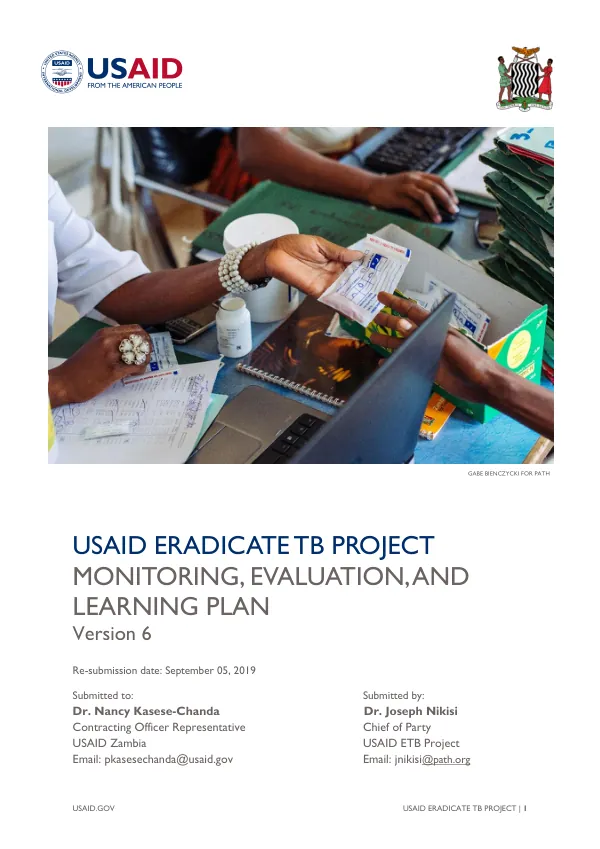
USAID/Zambia Eradicate TB Monitoring, Evaluation, and Learning Plan
The USAID Eradicate TB Project aims to strengthen the Government of the Republic of Zambia's response to eliminate tuberculosis in Zambia by 2035, in line with the global End TB Strategy and Zambia's National Strategic Plan for Tuberculosis Prevention, Care, and Control, 2017-2021.
2019 · 109 pages
Sign in to readA free account is required to download.
Abstract
The project will work with the National Tuberculosis Program (NTLP) to implement TB control and eradication activities in six provinces: Northern, Luapula, Muchinga, Copperbelt, Central, and North-Western provinces. These provinces have been identified as having high TB burdens. The project will focus on specific populations with high TB burdens, including prisons and mining communities, children, and people living with HIV/AIDS (PLHIV). The project will also support the NTLP to develop and implement strategies, guidelines, and protocols for TB control and eradication. This will involve working with the NTLP to strengthen the health system, improve TB case detection and treatment, and enhance community engagement and community-based TB services. The project will be implemented by PATH, in partnership with a consortium of organizations, including Afya Mzuri, CITAM, Zambart, Initiatives Inc., and ASLM2. The project will be led by a Chief of Party, who will be responsible for overall project management and coordination. The project will also have a Monitoring, Evaluation, and Learning (MEL) team, which will be responsible for tracking project progress, identifying areas for improvement, and providing recommendations for future project activities. The project will use a results-based approach, with a focus on achieving specific, measurable, achievable, relevant, and time-bound (SMART) objectives. The project will also use a data-driven approach, with a focus on collecting and analyzing data to inform project decisions and improve TB control and eradication efforts. The project will have several key indicators, including: * TB case detection and treatment rates * TB treatment success rates * TB mortality rates * TB prevalence rates * TB incidence rates The project will also have several key performance indicators (KPIs), including: * Number of TB cases detected and treated * Number of TB treatment success cases * Number of TB-related deaths averted * Number of TB cases prevented * Number of TB-related hospitalizations prevented The project will also have several key outputs, including: * Strengthened health system capacity for TB control and eradication * Improved TB case detection and treatment rates * Enhanced community engagement and community-based TB services * Improved TB treatment success rates * Reduced TB-related mortality rates The project will also have several key outcomes, including: * Reduced TB incidence rates * Reduced TB prevalence rates * Improved health outcomes for people living with HIV/AIDS (PLHIV) The project will be implemented over a period of five years, with a budget of $10 million. The project will be led by a Chief of Party, who will be responsible for overall project management and coordination. The project will also have a Monitoring, Evaluation, and Learning (MEL) team, which will be responsible for tracking project progress, identifying areas for improvement, and providing recommendations for future project activities. The project will have several key partners, including the National Tuberculosis Program (NTLP), the Ministry of Health, and several civil society organizations. The project will also have several key stakeholders, including the Government of the Republic of Zambia, the World Health Organization (WHO), and several international partners. The project will be implemented in six provinces, including Northern, Luapula, Muchinga, Copperbelt, Central, and North-Western provinces. The project will focus on specific populations with high TB burdens, including prisons and mining communities, children, and people living with HIV/AIDS (PLHIV). The project will also support the NTLP to develop and implement strategies, guidelines, and protocols for TB control and eradication. This will involve working with the NTLP to strengthen the health system, improve TB case detection and treatment, and enhance community engagement and community-based TB services. The project will also have several key activities, including: * Strengthening health system capacity for TB control and eradication * Improving TB case detection and treatment rates * Enhancing community engagement and community-based TB services * Improving TB treatment success rates * Reducing TB-related mortality rates