USAID. BUR. FOR POLICY AND PROGRAM COORDINATION
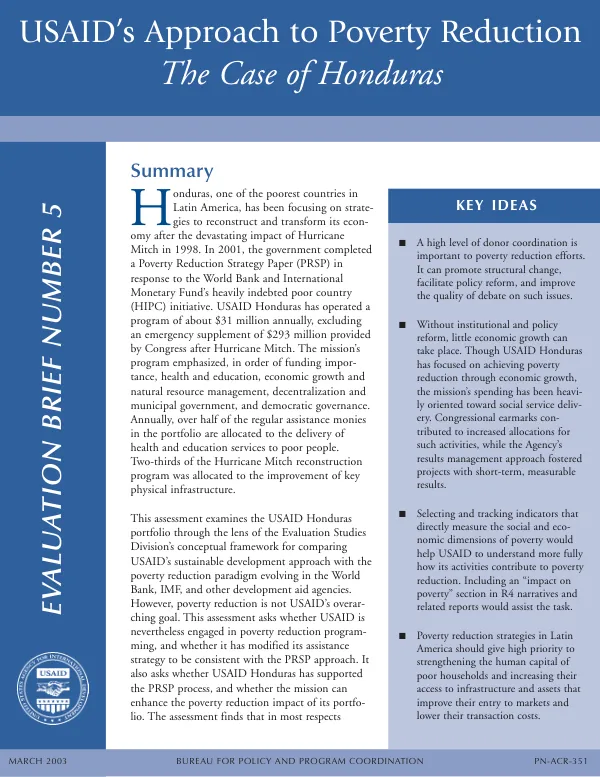
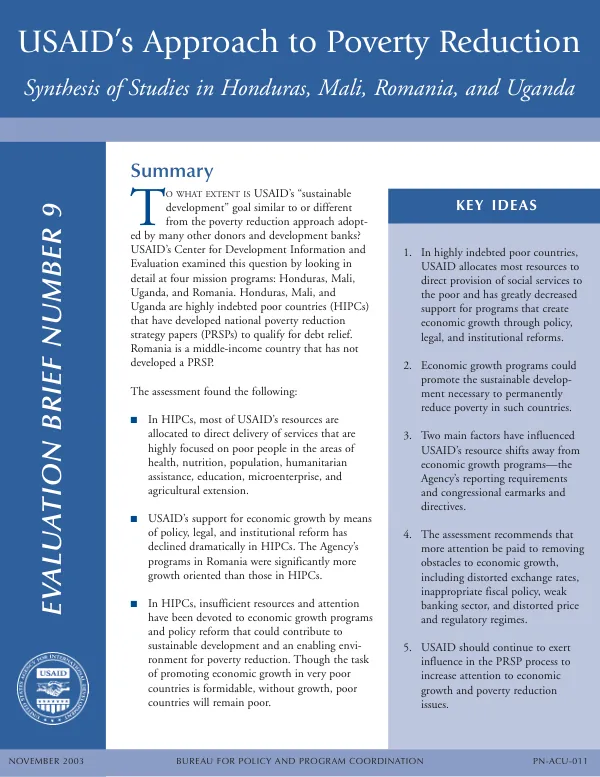
USAID"s approach to poverty reduction : the case of Honduras
In 2001, the Government of Honduras completed a Poverty Reduction Strategy Paper (PRSP) in response to the World Bank and International Monetary Fund"s heavily indebted poor country (HIPC) initiative.
Sleeper, Jonathan; Zuvekas, Clarence, Jr. · 2003
Sign in to readA free account is required to download.
Abstract
This assessment examines the extent to which USAID/Honduras is engaged in poverty reduction programming, and whether it has modified its assistance strategy to be consistent with the PRSP approach. It also asks whether USAID Honduras has supported the PRSP process, and whether the mission can enhance the poverty reduction impact of its portfolio. The assessment finds that in most respects USAID"s focus on broad-based sustainable development works effectively as a poverty reduction approach. More specific findings are as follows: (1) USAID/Honduras is one of the few agency management units that comes close to adopting poverty reduction as its overarching goal. (2) USAID"s program is well focused on the poor, especially in health and education, and incorporates many poverty reduction objectives. (3) Honduras needs additional policy and institutional reforms in many areas, particularly in public sector salary policy, rule of law, and modernization of the state. However, the mission"s portfolio is heavily skewed toward delivery of services, mainly due to congressional earmarks and the USAID results management system. Earmarks make it difficult for program officers to balance direct and indirect approaches to poverty reduction and to resolve inconsistencies between funding availability and program needs. (4) USAID played a key leadership role in the development of the Honduras PRSP. (5) Key to successful USAID involvement in the PRSP has been the high level of donor coordination achieved in Honduras. (6) The recent Honduran experience illustrates the importance of regarding poverty as a multidimensional concept.
Related documents