USAID DEC
USE OF ECONOMIC MODELS IN EVALUATING THE IMPACT OF RURAL DEVELOPMENT AND INCOME REDISTRIBUTION PROGRAMS IN THE LDC"S
Sign inOKLAHOMA STATE UNIVERSITY
USE OF ECONOMIC MODELS IN EVALUATING THE IMPACT OF RURAL DEVELOPMENT AND INCOME REDISTRIBUTION PROGRAMS IN THE LDC"S
Whether rural development results in a redistribution of income in favor of the poor is an unresolved question in the development literature.
APPLEGATE, M. J. · 1970
Sign in to readA free account is required to download.
Abstract
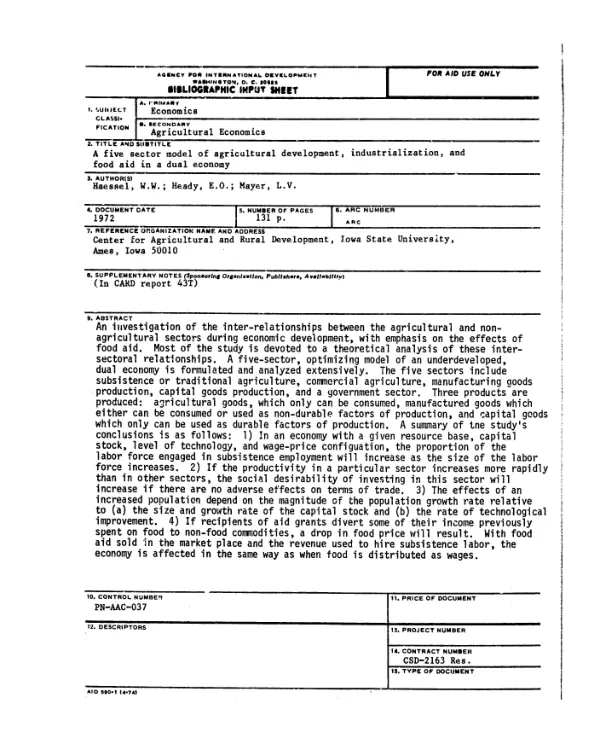
This study approaches this question by analyzing the use of existing economic models to evaluate the impact of rural development and allied income redistribution programs in LDCs. In part one, two-sector models of economic dualism are discussed in regard to their implications for improving income distribution between agricultural and nonagricultural sectors and for agricultural development policy. These models, and especially that of Mellor-Lele, imply that as technology stimulates agricultural growth and the increased agricultural output that results is consumed by agricultural labor, there will occur a decrease in marketable surplus which decreases employment opportunities in the nonagricultural sector. What is needed, therefore, is a balanced-growth strategy emphasizing both agricultural development through technology and investment in the nonagricultural sector. In part two, the use of quantitative techniques to measure the effects of changes in the size distribution of income is examined. The total impact as reflected by the savings and demand effects on relative factor intensities due to changes in the composition of demand are discussed. The author recommends that migration to the urban sector can improve the marginal productivity of labor, so industrialization should be encouraged. To prevent an income gap between rural and urban areas from occurring, an agricultural development program should also be implemented. In part three, some recent attempts to measure the effects of technology and of various inputs, such as credit and technical assistance, are analyzed. Increased technological inputs increase farmer options in selecting low-cost production methods. The final section presents a dynamic multisectoral model of Guatemala used for measuring the effects both of technological change in the traditional agricultural sector and of a proposed land reform program. A bibliography containing 40 titles (1954-1974) in both English and Spanish is also included.