USAID DEC
Use of rate of return for agricultural research priority setting : examples from Uganda
Sign inMAKERERE UNIVERSITY
Use of rate of return for agricultural research priority setting : examples from Uganda
Benefit-cost analysis was used to analyze the rate of return (ROR) to agricultural research on maize and oilseeds in Uganda.
Laker-Ojok, Rita · 1993
Sign in to readA free account is required to download.
Abstract
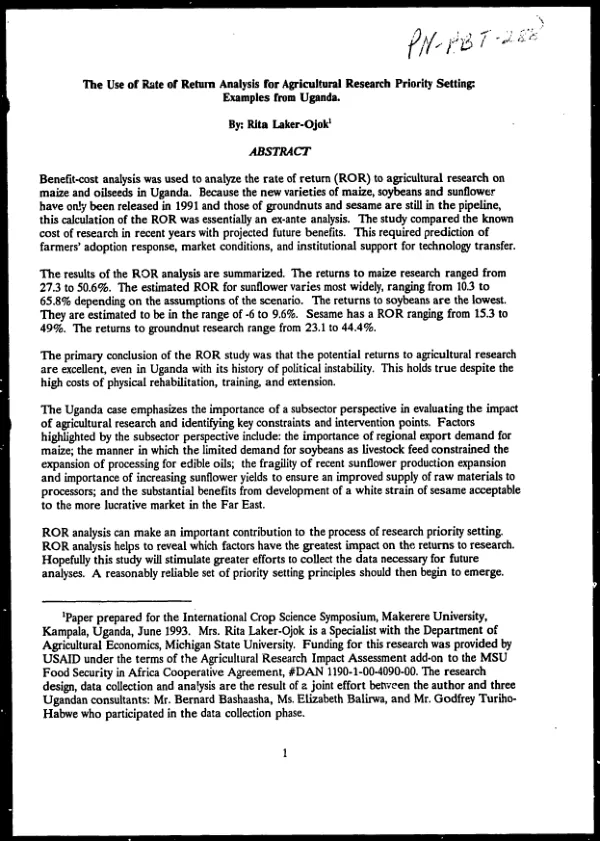
Because the new varieties of maize, soybeans, and sunflower have only been released in 1991 and those of groundnuts and sesame are still in the pipeline, this calculation of the ROR was essentially in ex-ante analysis. The study compared the known cost of research in recent years with projected future benefits. This required prediction of farmers" adoption response, market conditions, and institutional support for technology transfer. The results of the ROR analysis are summarized. The returns to maize research ranged from 27.3 to 50.6%. The estimated ROR for sunflower varies most widely, ranging from 10.3 to 65.8%, depending on the assumptions of the scenario. The returns to soybeans are the lowest. They are estimated to be in the range of -6 to 9.6%. Sesame has a ROR ranging from 15.3 to 49%. The returns to groundnut research range from 23.1 to 44.4%. The primary conclusion of the ROR study was that the potential returns to agricultural research are excellent, even in Uganda with its history of political instability. This holds true despite the high costs of physical rehabilitation, training, and extension. (Author abstract)
Connected topics