SYNECTICS CORP.
USE OF THE CHILD"S GROWTH CHART AS AN EDUCATIONAL TOOL
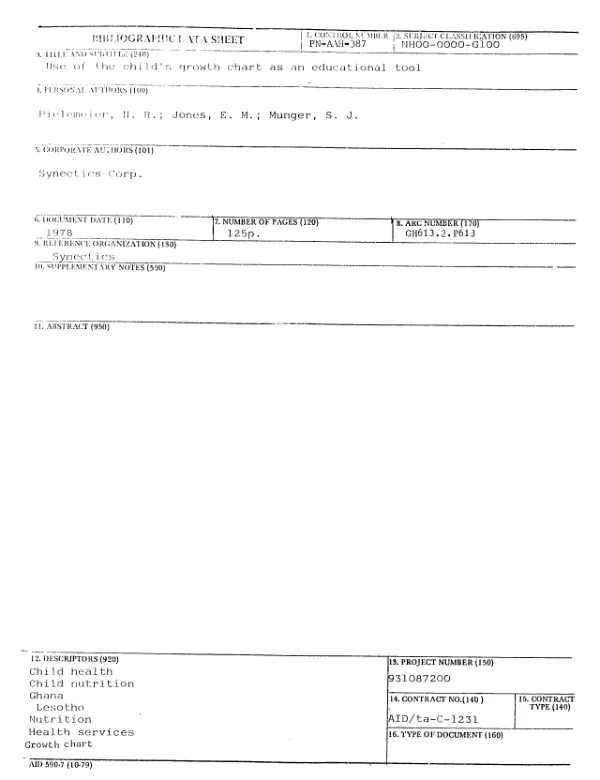
This document reports on a study assessing the effectiveness of child growth charts as an educational tool in LDC mother/child health clinics.
PIELEMEIER, N. R.; JONES, E. M. +1 more · 1970
Sign in to readA free account is required to download.
Abstract
Ghana and Lesotho were chosen as sites for the study which took place during 6/76 to 6/78. Three rounds of field interviews were conducted, with a six-months time lapse between interviews. The interviews were used to obtain background information on the participating clinics, communities, and families; to determine the mothers" knowledge of nutrition and attitudes about food; and to record growth rates of the children. Also, during the interviews mothers were taught (using charts) to recognize the following conditions: normal growth with no illness, severe malnutrition, weight loss, and diarrhea. In addition, the growth chart of the mother"s own child was related to feeding and other child-care practices. The study revealed extensive and effective use of growth charts among the surveyed clinics in both Lesotho and Ghana. In Lesotho, the vast majority of the mothers were able to understand and use the growth charts during the first interview. In Ghana, initial comprehension was not so high, but the mothers" performances improved over the study period. One of the most serious implications of the study is that the comparative value of growth charts over other educational methods could be better explored in a series of smaller-scale and better controlled investigations. The report includes tables of data resulting from the interviews and a two-page bibliography (1961-78) of other reports and studies on nutrition and the use of growth charts.
![Nutrition of infants and young children in Zimbabwe : findings from the 1994 Zimbabwe DHS [demographic and health survey] survey](https://covers.devme.ai/gen/73753.webp)