USAID DEC
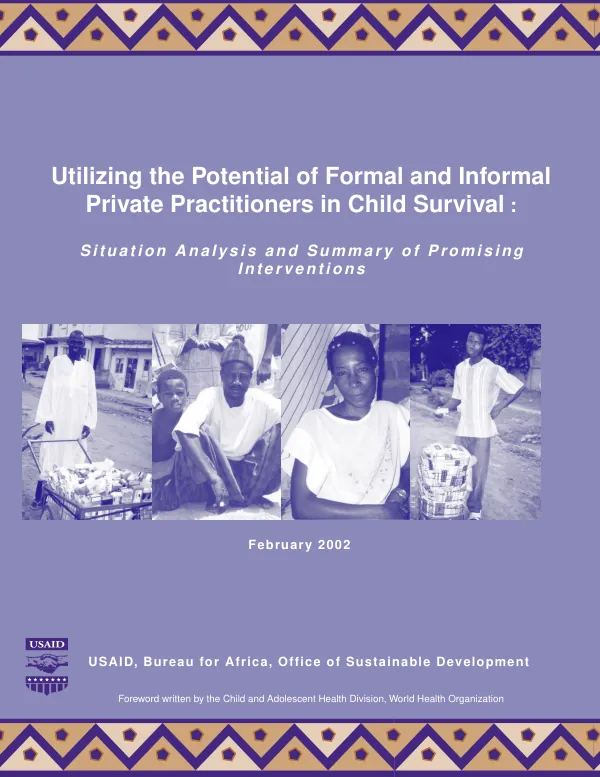
Utilizing the potential of formal and informal private practitioners in child survival : situation analysis and summary of promising interventions
Sign inACADEMY FOR EDUCATIONAL DEVELOPMENT, INC. (AED)
Utilizing the potential of formal and informal private practitioners in child survival : situation analysis and summary of promising interventions
Formal and informal private practitioners are popular sources of treatment for diarrhea, acute respiratory infection, and malaria, which are major causes of childhood mortality in developing countries.
Tawfik, Youssef; Northrup, Robert +1 more · 2002
Sign in to readA free account is required to download.
Abstract
Private practitioners are generally perceived by the community to be more accessible, more sensitive to client needs, and more willing to spend time with their clients than their public sector counterparts. However, because of the wide evidence of their substandard clinical services, most national health policies prohibit the practice of unqualified practitioners and ignore them in national child survival programs. This paper analyzes interventions to improve private practitioners" case management of childhood diseases, concluding that most interventions have only been tested on a small scale, with few adequately documented or evaluated. The review found that interventions that only address practitioner knowledge are unlikely to succeed. By contrast, realistic interventions that focus on improving a limited number of key practices, consider the multiple factors influencing practitioners" practices, use local entities that are trusted by the targeted practitioners, and treat practitioners as health "partners" are more likely to succeed. Considering the high proportion of sick children treated by formal and informal private practitioners, often ineffectively or unsafely, continuing to ignore these providers is no longer acceptable. The paper ends by offering guidance for designing effective strategies to improve the ability of private practitioners to provide effective treatment, counseling, and referral of sick children.
Related documents
Documents in this collection
 2001
2001USAID DEC
Utilizing the potential of formal and informal private practitioners in child survival in Uganda : situation analysis and outline for developing a national strategy
Open record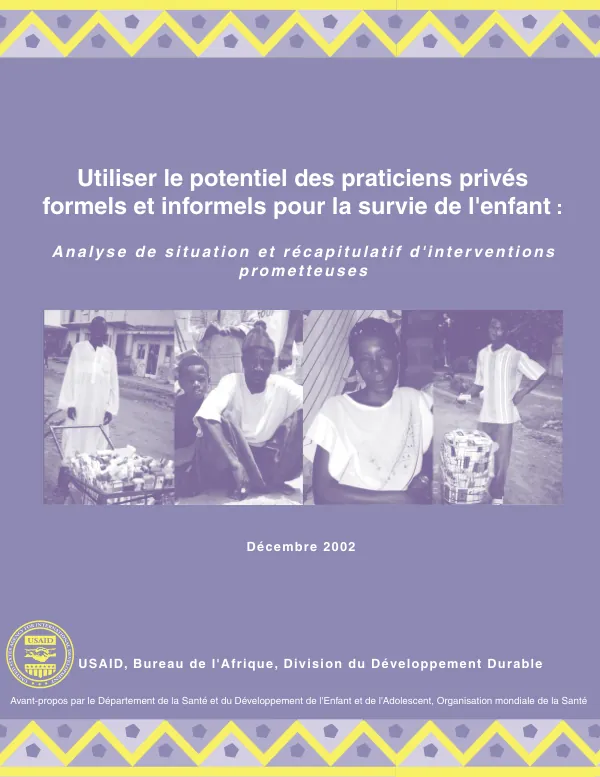 2002
2002USAID DEC
![CDD [control of diarrheal diseases] and ARI [acute respiratory infection] programs in sub-Saharan Africa : redefining their roles in a changing context = Programmes de LMD [lutte contre les maladies diarrheiques] et IRA [infections respiratoires aigues] en Afrique subsaharienne : redefinir leurs roles dans un contexte changeant](https://covers.devme.ai/gen/65172.webp)