USAID
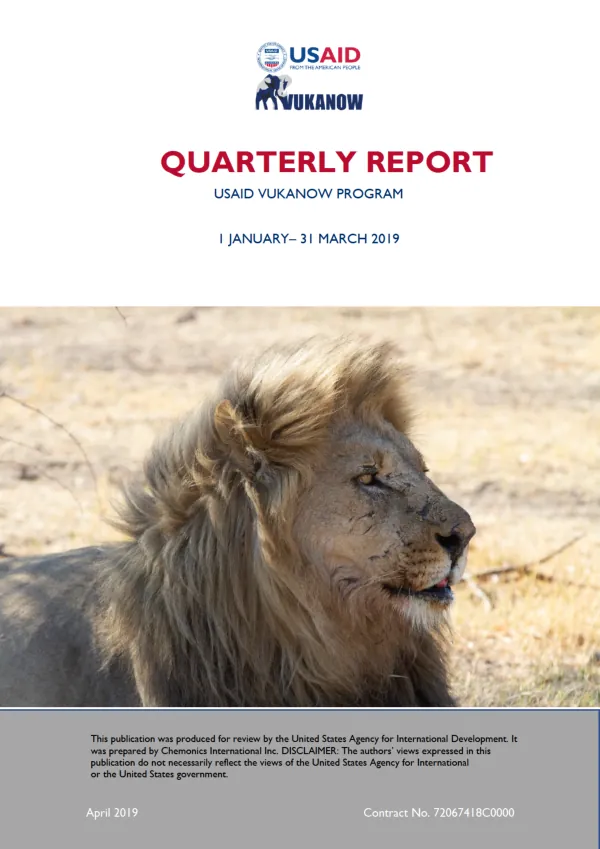
UVN Quarterly Progress Report Jan-Mar 2019
The USAID's VukaNow (UVN) activity is a regional program aimed at addressing wildlife crime in Southern Africa.
2019 · 27 pages
Sign in to readA free account is required to download.
Abstract
The program was launched in March 2018 to complement six projects in four landscapes across the region. The goal of the UVN activity is to significantly reduce the level of poaching and illegal trade in wildlife and to enhance law enforcement capacity and promote sustainable utilization of natural resources. The program has two integrated strategic objectives: Objective 1, Catalyze learning and sharing for improved results to combat wildlife crime, and Objective 2, Increase collaborative action to reduce wildlife crime in targeted areas. The approach of the UVN program is rooted in a theory of change and a fundamental belief that a collective impact model is necessary to achieve USAID's goal of dramatically decreasing wildlife crime across Southern Africa. During the first quarter of 2019, UVN activities included implementing a regional activity that complements other efforts through sharing of best practices, supporting common research themes to inform project implementation and management, and development of an integrated regional capacity building program within and across the landscapes. The UVN team closely engaged with landscape partners to see where the program can best support their efforts. Specific activities included increasing understanding of the dynamics of and ways to disrupt wildlife crime, including specific trafficking routes in the target landscapes and the region. The UVN team worked with consultant James Bradley to carry out a hotspot analysis of poaching and illegal wildlife trade across Southern Africa using the Delphi Technique research approach. The initial report on the first stage of research was completed, providing a refined expert-based perspective on the problem. The UVN program recognizes that landscape partners are already in the midst of implementing activities in their landscapes. The program aims to support their efforts by providing a platform for sharing best practices, supporting common research themes, and developing an integrated regional capacity building program. By working closely with landscape partners, the UVN program seeks to catalyze learning and sharing for improved results to combat wildlife crime and increase collaborative action to reduce wildlife crime in targeted areas. The program's approach is rooted in a theory of change that acknowledges the complex socioeconomic and political conditions that contribute to wildlife crime. The theory of change recognizes that wildlife crime is a multi-billion-dollar illicit business that decimates Africa's iconic animal populations and undermines the economic prosperity and sustainable development of countries and communities throughout Southern Africa. The UVN program's quarterly report highlights the progress made during the first quarter of 2019. The report provides an overview of the program's activities, including the implementation of a regional activity, engagement with landscape partners, and the completion of a hotspot analysis of poaching and illegal wildlife trade across Southern Africa. The report also highlights the program's commitment to supporting landscape partners and promoting collaborative action to reduce wildlife crime in targeted areas. The UVN program's approach to addressing wildlife crime is grounded in a collective impact model that recognizes the need for a coordinated effort to achieve significant reductions in poaching and illegal trade in wildlife. The program's theory of change acknowledges the complex socioeconomic and political conditions that contribute to wildlife crime and seeks to address these conditions through a comprehensive approach that includes sharing best practices, supporting common research themes, and developing an integrated regional capacity building program.
Related documents