USAID
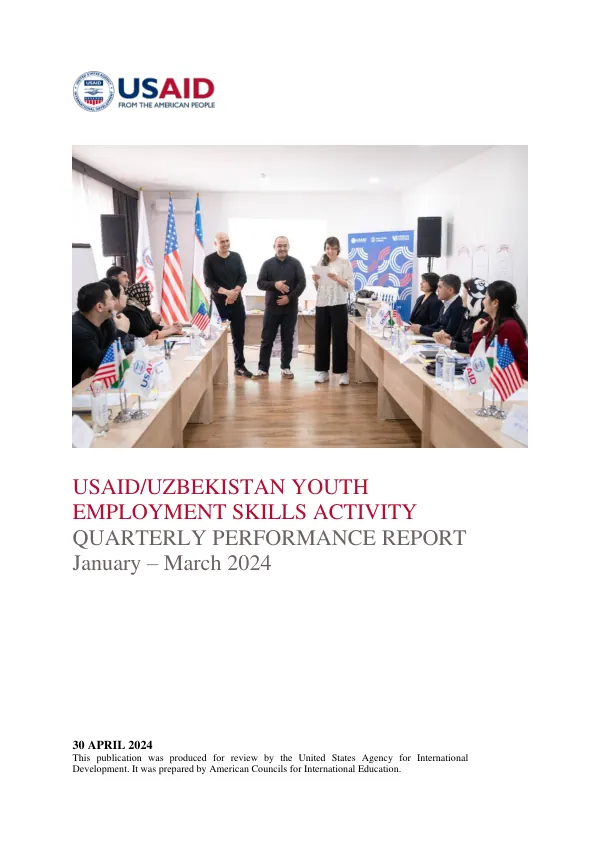
Uzbekistan Youth Employment Skills Activity Annual Performance Report FY23
The Uzbekistan Youth Employment Skills (YES) Activity aims to increase youth work readiness and employability in Uzbekistan.
2023 · 38 pages
Sign in to readA free account is required to download.
Abstract
Launched in January 2022, the five-year, $10 million activity is implemented by a consortium of partners, including American Councils for International Education as the lead organization, World Learning, Startup Factory, Sharoit Plus, and Ergo Analytics. The activity focuses on three objectives: improving the quality of school-based economics and entrepreneurship programs, improving the quality of after-school entrepreneurship, soft skills, and work readiness programs, and strengthening the enabling environment to support and engage youth. The activity partners with the Ministry of Preschool and School Education (MoPSE) and the private sector to update curricula and teaching and learning materials used for Grades 8-11 entrepreneurship and economics instruction. The revised curricula will be tested in schools in the target pilot region in a randomized control trial (RCT). To improve the quality of after-school entrepreneurship, soft skills, and work readiness programs, the activity will continue strengthening its partnership with MoPSE and private sector stakeholders, while also partnering with local government and community groups in the target pilot region. The activity will focus on building attitudes and corresponding behaviors conducive to youth, women, and girls, and people with disabilities entering the workforce. All activities under Objective 3 will target and support behavior change in four groups in the target pilot region: youth participants (Grades 8-11), parents, teachers/mentors, and employers. The activity will actively engage the private sector, from a diverse group of businesses, with a key focus on forging sustainable relationships and mechanisms for communication between MoPSE and private sector actors, and on enacting policy or procedural-level change through targeted involvement with government. During FY23 Q2, the Ministry of Preschool and School Education signed the long-awaited Memorandum of Understanding (MOU) with American Councils for International Education on March 27. This MOU was a prerequisite for collaboration with the Ministry of any of its schools or departments. The signing of the MOU allowed the YES Activity to proceed with program implementation, which had been delayed due to the lack of a signed MOU. The YES Activity has made significant progress in implementing its objectives. In the area of school-based economics and entrepreneurship programs, the activity has partnered with MoPSE agencies and the private sector to update curricula and teaching and learning materials. The revised curricula will be tested in schools in the target pilot region in a randomized control trial (RCT). In the area of after-school entrepreneurship, soft skills, and work readiness programs, the activity has continued strengthening its partnership with MoPSE and private sector stakeholders, while also partnering with local government and community groups in the target pilot region. The activity has also made progress in strengthening the enabling environment to support and engage youth. The activity has actively engaged the private sector, from a diverse group of businesses, with a key focus on forging sustainable relationships and mechanisms for communication between MoPSE and private sector actors, and on enacting policy or procedural-level change through targeted involvement with government. The YES Activity has also made significant progress in implementing its activities in the target pilot region. The activity has partnered with local government and community groups to implement its activities, including the development of curricula and teaching and learning materials, and the provision of training and capacity-building programs for teachers and mentors. Overall, the YES Activity has made significant progress in implementing its objectives and activities in the target pilot region. The activity has partnered with MoPSE and the private sector to update curricula and teaching and learning materials, and has continued strengthening its partnership with MoPSE and private sector stakeholders. The activity has also actively engaged the private sector, from a diverse group of businesses, with a key focus on forging sustainable relationships and mechanisms for communication between MoPSE and private sector actors, and on enacting policy or procedural-level change through targeted involvement with government.