ACADEMY FOR EDUCATIONAL DEVELOPMENT, INC. (AED)
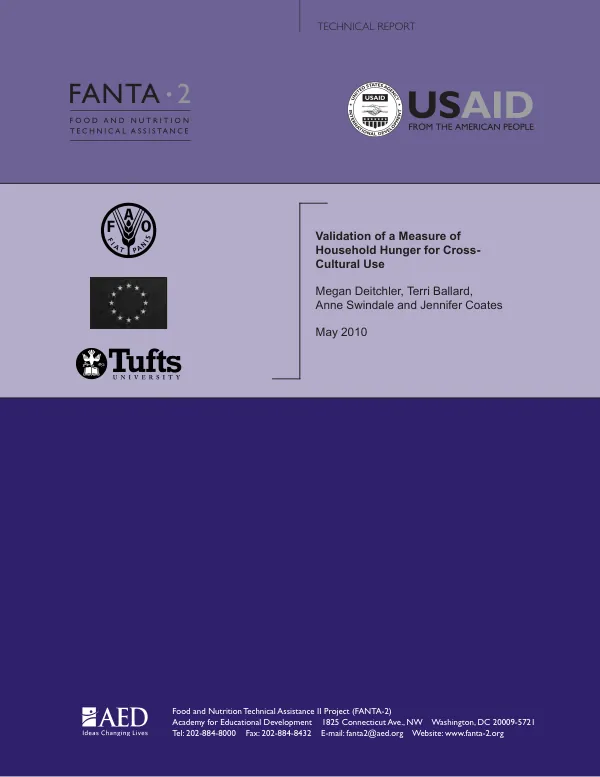
Validation of a measure of household hunger for cross-culture use
This report describes the findings from a validation study of the Household Food Insecurity Access Scale (HFIAS), a 9 item 4 frequency (9I 4F) measurement scale to assess the access component of household food insecurity in resource-poor areas.
Deitchler, Megan; Ballard, Terri · 2010
Sign in to readA free account is required to download.
Abstract
The United States Agency for International Development (USAID)-funded Food and Nutrition Technical Assistance (FANTA) project developed the HFIAS in 2006 with the aim to provide a simple tool that would provide statistically valid (internally valid), accurate and reliable information about the prevalence of food insecurity at a population level (externally valid) and directly comparable data upon use of the tool in diverse settings (cross-culturally valid). In this study, the extent to which the objectives of internal, external and cross-cultural validity have been achieved are examined. To do so, seven HFIAS data sets were collected in diverse contexts and countries: Mozambique (two data sets), Malawi, West Bank/Gaza Strip, Kenya, Zimbabwe and South Africa. Statistical methods were applied based on the Rasch measurement model to assess the performance of the HFIAS and use the results of these analyses to revise the HFIAS, as necessary. To help interpret the empirical results, it also refers to qualitative feedback on the HFIAS provided by collaborators who contributed data to the study. (Author abstract, modified)
Connected topics
Related documents