TETRA TECH EM, INC.
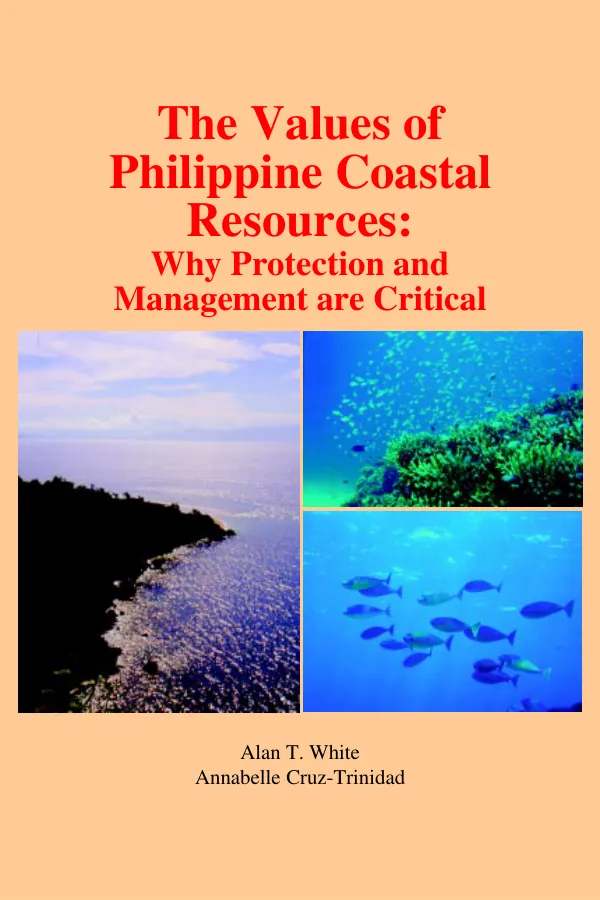
Values of Philippine coastal resources : why protection and management are critical
This book documents the value of Philippine coastal resources and the critical importance of protecting them.
White, Alan T.; Cruz-Trinidad, Annabelle · 1970
Sign in to readA free account is required to download.
Abstract
After an introductory chapter on resource valuation methods, chapter 2 shows that coral reefs are the most productive ecosystem in the world and provide immense benefits. To destroy coral reefs is to destroy income for various beneficiaries by $50,000/km2/year of healthy coral reef. The potential fish catch alone from a healthy coral reef is enough to justify sizable management costs. Chapter 3 focuses on mangroves, a very productive ecosystem that is highly threatened in the Philippines. The average annual conservative return used for Philippine healthy mangrove forests and habitats is $600/ha/year. Also, replanting abandoned or degraded mangroves is economically feasible. Chapter 4 examines the large fishery resources of the Philippines in the context of habitat destruction and overfishing. Although the country depends heavily on fishing for food, livelihood, and export income, fisheries are beginning to decline. There is clear evidence of overfishing in all the important fisheries of the country, resulting in decreases in overall catch, in catch per unit effort (person, boat, or horsepower), and in profits. Investment capital is severely misallocated in commercial fishing, which, with only 6% of the fishing workforce, has 30% of the catch, leaving few fish for the small- scale and municipal fishing sectors. The loss in economic rent for the small pelagic fishery alone probably totals more than $0.5 billion annually; total losses are much higher if all fisheries are considered. Chapter 5 analyzes the importance of coastal water quality in maintaining viable fisheries and habitats such as coral reefs and mangroves, and presents evidence of increasing water pollution, the losses from which will be equal to all the potential benefits from the other systems of concern. One way to measure the potential losses from pollution is to estimate the willingness-to-pay of polluters for losing their ability to dump into the ocean or a river for free. This willingness-to-pay was estimated for the whole of Lingayen Gulf polluters to be around P366 million annually, which is probably a conservative estimate of what is actually lost in terms of decreased fish catch and lowered tourism appeal in the Gulf. Chapter 6 proposes integrated coastal management (ICM) as an approach that will begin to integrate the needed actions into a more holistic management framework; it is generally agreed that piecemeal and single sector approaches are no longer viable. Includes references.