USAID. MISSION TO DOMINICAN REPUBLIC
Vector control
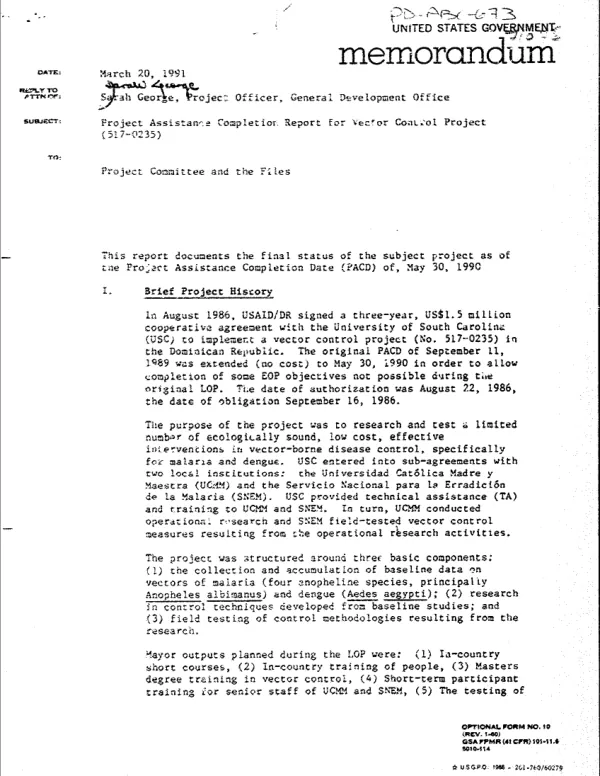
Project to help the Dominican Republic develop an institutional capacity to research and test a limited number of ecologically sound, low-cost vector control methods for malaria and dengue.
1986
Sign in to readA free account is required to download.
Abstract
The project will be implemented by the National Malaria Eradication Service (SNEM), the Universidad Catolica Madre y Maestra (UCMM), and the University of South Carolina"s (USC) International Center for Public Health Research. Three basic activities will be carried out: collection of baseline data; research into control methods; and field testing of selected control techniques. Baseline data will be collected in areas where rates of dengue and malaria incidence are highest. The project team will identify: mosquito vectors, their population levels, levels of insecticide resistance or avoidance, transmission rates, and the time and place of contact between human and vector. It will also assess breeding sources and identify areas for evaluation of new control methods. Periodic surveys will be conducted in the same areas throughout the project to detect any change in the mosquito population. Various vector control methods will researched, including, e.g., introducing small larvicidal fish into water storage barrels, introducing a cannibalistic mosquito that does not bite people but whose larvae consume the larvae of the dengue-carrying Aedes aegypti mosquito, adding chemicals to mosquito breeding sites, and refining spraying strategies. The control methods will be tested in at least three areas which the baseline studies have identified as possessing high levels of disease transmission and diverse ecological conditions and mosquito producing habitats. Finally, methods which meet evaluation criteria with regard to effectiveness, duration, cost, ease of application, and safety for other organisms will be field tested by SNEM personnel to determine if it is feasible to apply them on a larger scale. The project will fund training of UCMM and SNEM staff, including, USC Master"s degrees in public health for 3 persons, short-term USC training for 7, an observation tour for key staff, and a wide range of short-term in-country training, the latter particularly for SNEM field supervisors and voluntary collaborators. Also, health workers throughout the country will receive training in malaria surveillance and vector control.