USAID DEC
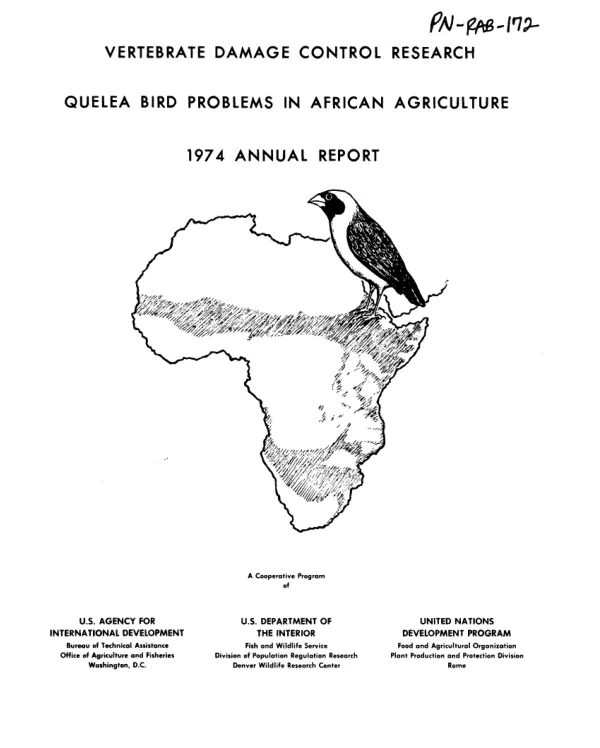
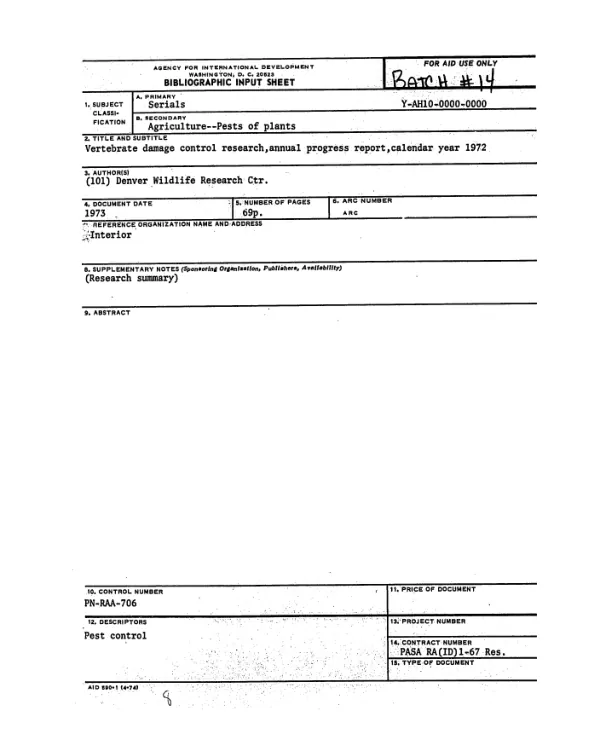
VERTEBRATE DAMAGE CONTROL RESEARCH; QUELEA BIRD PROBLEMS IN AFRICAN AGRICULTURE : 1973 ANNUAL PROGRESS REPORT
Sign inU.S. DEPT. OF THE INTERIOR. FISH AND WILDLIFE SERVICE. DENVER WILDLIFE RESEARCH CENTER
VERTEBRATE DAMAGE CONTROL RESEARCH; QUELEA BIRD PROBLEMS IN AFRICAN AGRICULTURE : 1973 ANNUAL PROGRESS REPORT
Two trips were made to the African Continent and a side trip to Turkey during the January-May period as a part of continuing AID/BSFW investigations on vertebrate pest problems.
1970
Sign in to readA free account is required to download.
Abstract
These trips were undertaken with four main objectives: (1) to continue gathering information on bird and rodent damage problems that occur in African agriculture; (2) to continue cooperative studies on quelea with personnel in Chad and Eastern Africa; (3) to develop plans for an AID/BSFW program and cooperative studies in Eastern Africa; and (4) in Turkey, to obtain information on bird and rodent damage problems and on the use of dogs for protecting domestic sheep from wolves. Quelea quelea (Black-faced Dioch), has been reported to adversely affect the economy of 25 nations in Africa and has the distinction of being the most numerous and destructive bird in the world. Quelea damage millet, sorghum, rice, and wheat. Recognition of the problem dates back to the late 1800"s, but has only recently received international attention. Since 1950, many methods of quelea control have been devised and millions of birds have been destroyed. Aerial applications with high concentrations of very potent pesticides in roosting and nesting sites is the damage control method currently being used almost exclusively by many governments in Africa. Although heavy annual kills are made, populations have not decreased, indicating simply that surplus birds are being harvested. Present bird control techniques need refining and other methods of crop protection should be investigated and developed. Basic research on bird behavior, movement, damage, and on selective chemicals are also requirements for the future. FAO personnel headquartered at Ft. Lamy, Chad, have begun much of this basic research. It is recommended that AID/BSFW become directly involved in the quelea problem and other important vertebrate pest problems by establishing a research project in Eastern Africa as soon as possible in 1974.
Related documents