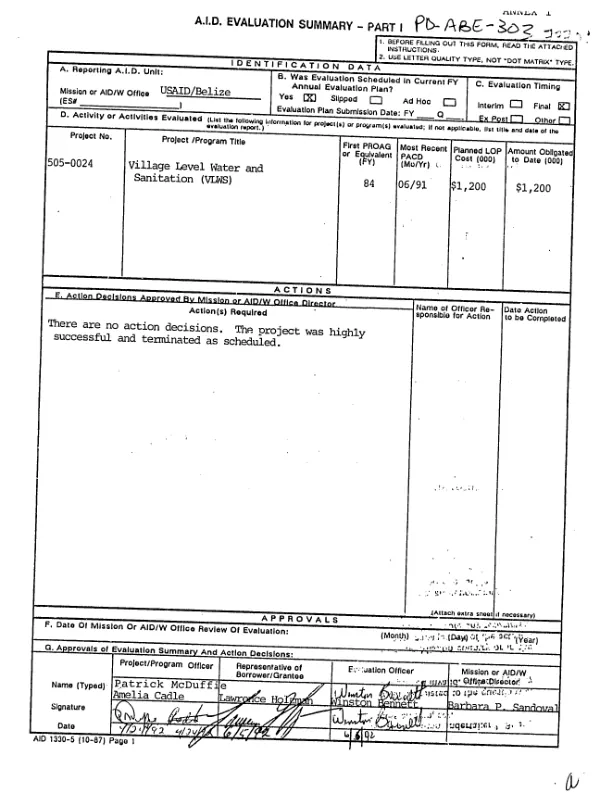
USAID. MISSION TO BELIZE
Village level water and sanitation (VLWS)
Summarizes midterm evaluation (PD-AAX-015), covering the period 8/84-4/87, of a CARE project to provide water supply and sanitation facilities to 16 villages in the Orange Walk and Corozal Districts of Belize.
1988
Sign in to readA free account is required to download.
Abstract
For evaluation findings, see the abstract of PD-AAX-015. Several lessons learned are noted. (1) Traditional water sources, particularly rainwater and dug wells, will continue to be used where potable water is supplied from handpumps that are located 150-200 or more feet from the house. The quantity of water used and even the willingness to use a handpump decline as the distance from house to handpump increases. (2) For long-term project sustainability and community development, project staff (including counterparts) must be trained in community development and involve the community in many more aspects of the project. (3) The development of a Village Water and Sanitation Committee in each community has been an extremely effective method of avoiding the political conflicts that tend to polarize community organization efforts. (4) The success of the latrine construction program is most likely due to both the project"s health education efforts and an existing awareness of the need for latrines. (5) Community studies that use villagers as surveyors and focus on observing existing conditions and practices can be far more useful than elaborate baseline studies in assessing needs and monitoring health education efforts. (6) The project has shown that a water supply project that is narrowly focused - using only handpumps - does not adequately address the needs of all of the communities. (7) The project"s self-help nature has introduced the important concept that villagers can improve their communities through their own efforts, with less reliance on the Government. (8) Community development means more than participation in either project implementation or self-help. Action decisions are to: (1) reactivate the National Coordinating Committee on Water Supply and Sanitation; (2) assign additional staff for health education and community organization; (3) develop indicators of community development/organization and place more emphasis on developing staff skills in this area; (4) seek long-term drilling advisors; (5) improve management practices for drilling/repair crews; and (6) develop standardized manuals for maintaining handpumps, latrines, and rudimentary water systems.
Related documents
![Technical assistance [evaluation] report : village level water and sanitation (VLWS) project](https://covers.devme.ai/gen/22495.webp)
![Technical assistance [evaluation] report : village level water and sanitation (VLWS) project](https://covers.devme.ai/gen/8348.webp)