TULANE/PRAGMA GROUP
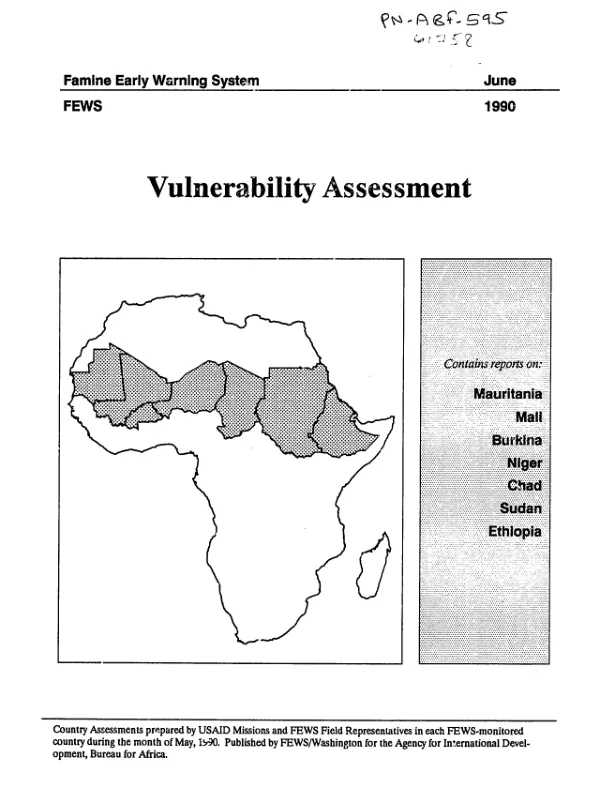
Vulnerability assessment : Mauritania, Mali, Burkina, Niger, Chad, Sudan, Ethiopia
Social upheaval has increased vulnerability to famine in the Sahel.
1990
Sign in to readA free account is required to download.
Abstract
This report assesses food security in seven countries in the region -- Mauritania, Mali, Burkina Faso, Niger, Chad, Sudan, and Ethiopia -- focusing on the socioeconomic factors that affect access to food. Forced relocations in Mauritania have placed 80,000 people at-risk in 1990, while civil war has endangered 2-3 million people in both Sudan and Ethiopia. Poor environmental and agroclimatic conditions are primarily responsible for the extremely vulnerable groups in Mali (200,000), Niger (160,000), and Chad (19,000). Although these groups are receiving assistance, the at-risk population in Mali was hurt by response delays arising from government and donor disagreement over levels and locations of vulnerability. Populations in Burkina Faso are only moderately vulnerable as the 1990/91 agricultural season begins, but a poor 1990/91 rain and agricultural season would increase vulnerability and probability of famine in Burkina and throughout the region. While the report"s analysis is country- specific, some regional patterns do emerge. (1) Most of those at risk -- the overwhelming majority of whom are in Sudan and Ethiopia -- are not currently receiving substantial food assistance. (2) Armed conflict, not drought, is the primary reason for the vulnerability of over half of the at-risk populations. (3) Agriculturalists and agropastoralists, rather than pastoralists, make up most of the extremely vulnerable groups. (4) Over half of the at-risk populations are not, or are only tenuously, under the control of the governments of the countries in which they reside. (5) Most at-risk groups have experienced at least two similar periods of food insecurity in the last five years (particularly following the 1984 and 1987 harvests).
Related documents
![Harvest assessment of cereal production : Mauritania, Mali, Burkina [Faso], Niger, Chad, Sudan, Ethiopia](https://covers.devme.ai/gen/56948.webp)
![Pre-harvest assessment of cereal production : Mauritania, Mali, Burkina [Faso], Niger, Chad, Sudan, Ethiopia](https://covers.devme.ai/gen/64799.webp)
![Pre-harvest assessment : Mauritania, Mali, Burkina [Faso], Niger, Chad, Ethiopia and Eritrea](https://covers.devme.ai/gen/75543.webp)
![Evaluation de la vulnerabilite avec des rapports sur : la Mauritanie, le Mali, le Burkina [Faso], le Niger, le Tchad, le Soudan, l"Ethiopie](https://covers.devme.ai/gen/29737.webp)
![Harvest assessment February 1993 : Mauritania, Mali, Burkina [Faso], Niger, Chad, Ethiopia and Eritrea](https://covers.devme.ai/gen/67179.webp)