USAID DEC
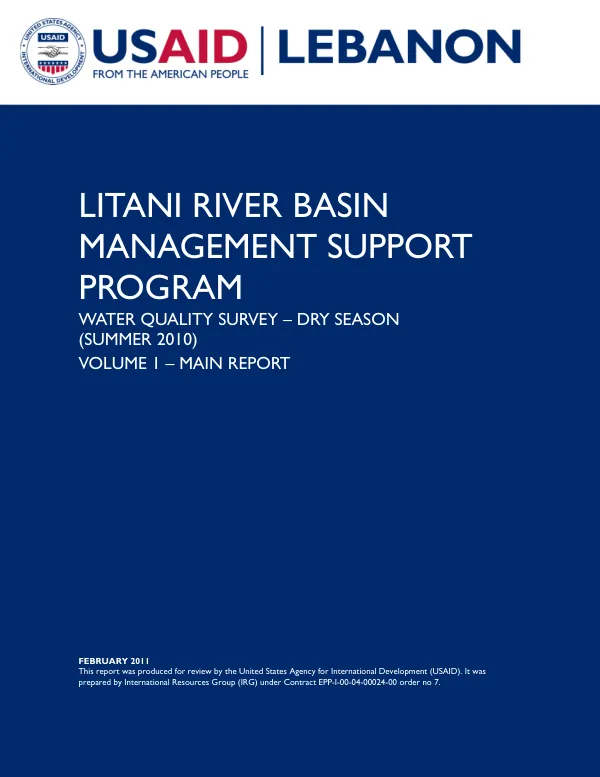
Water Quality Survey – Dry Season (Summer 2010) for Litani River Basin Management Support Program
Sign inINTERNATIONAL RESOURCES GROUP
Water Quality Survey – Dry Season (Summer 2010) for Litani River Basin Management Support Program
The Litani River Basin Management Support Program was established to address water quality concerns in the region.
2011 · 210 pages
Sign in to readA free account is required to download.
Abstract
The program's objectives include improving water quality, reducing pollution, and enhancing the overall health of the Litani River Basin. The program's components include water quality monitoring, wastewater management, and soil quality assessment. The study objectives and work plan for the water quality survey were outlined in the report. The study aimed to assess the water quality of the Litani River, Qaraoun Lake, and Irrigation Canal 900, as well as the groundwater quality in the region. The work plan included preparatory work, sampling campaigns, field and reconnaissance surveys, and the development of procedural guidelines and log forms for sample collection. The study methodology involved sampling the Upper Litani Basin, Qaraoun Lake, and Irrigation Canal 900. The sampling campaign framework was designed to collect water and sediment samples from various locations in the region. The field and reconnaissance surveys were conducted to identify potential sources of pollution and to assess the water quality of the Litani River and its tributaries. The results of the field study of the Upper Litani Basin showed that the water quality varied significantly across different zones. The Yellow Zone, which is the upper zone of the basin, had the poorest water quality, with high levels of turbidity and suspended solids. The Orange Zone, which is the middle zone of the basin, had moderate water quality, while the Green Zone, which is the lower zone of the basin, had the best water quality. The Litani River water quality assessment showed that the river's water quality was affected by domestic, irrigation, and livestock water use. The domestic water use was found to be a significant source of pollution, with high levels of bacteria and nutrients detected in the water samples. The irrigation water use was also found to be a significant source of pollution, with high levels of suspended solids and nutrients detected in the water samples. The groundwater quality assessment showed that the groundwater quality was affected by the presence of bacteria, nutrients, and other pollutants. The water springs quality assessment showed that the water springs in the region were contaminated with bacteria and other pollutants. The well water quality assessment showed that the well water in the region was contaminated with bacteria, nutrients, and other pollutants. The Qaraoun Lake water quality assessment showed that the lake's water quality was affected by the presence of bacteria, nutrients, and other pollutants. The lake's water quality was found to be poor, with high levels of turbidity and suspended solids detected in the water samples. The Irrigation Canal 900 water quality assessment showed that the canal's water quality was affected by the presence of bacteria, nutrients, and other pollutants. The canal's water quality was found to be poor, with high levels of turbidity and suspended solids detected in the water samples. The wastewater quality assessment showed that the wastewater in the region was contaminated with bacteria, nutrients, and other pollutants. The domestic wastewater was found to be a significant source of pollution, with high levels of bacteria and nutrients detected in the wastewater samples. The soil quality assessment showed that the soil quality in the region was affected by the presence of pollutants such as heavy metals and pesticides. The sediments quality assessment showed that the sediments in the Litani River and Qaraoun Lake were contaminated with pollutants such as heavy metals and pesticides. The conclusion and recommendations of the report highlighted the need to restore the Litani River's health and wellbeing, protect and sustain the quality of groundwater resources, regulate the use of wastewater for irrigation, enhance the water quality of Qaraoun Lake, and enhance the quality of Irrigation Canal 900. The report also recommended the development of a sustainable water quality monitoring program and the completion of a risk analysis process to identify potential sources of pollution and to develop strategies to mitigate them.
Related documents