CORNELL UNIVERSITY. CENTER FOR INTERNATIONAL STUDIES
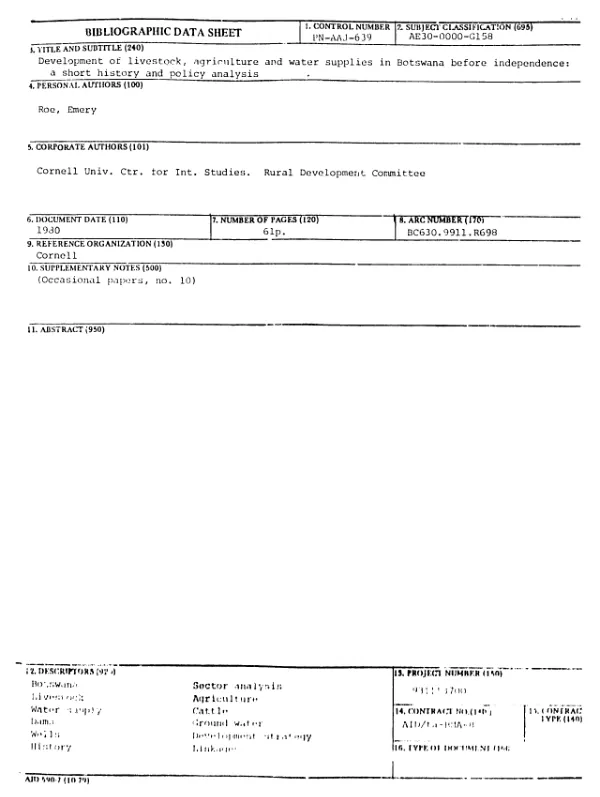
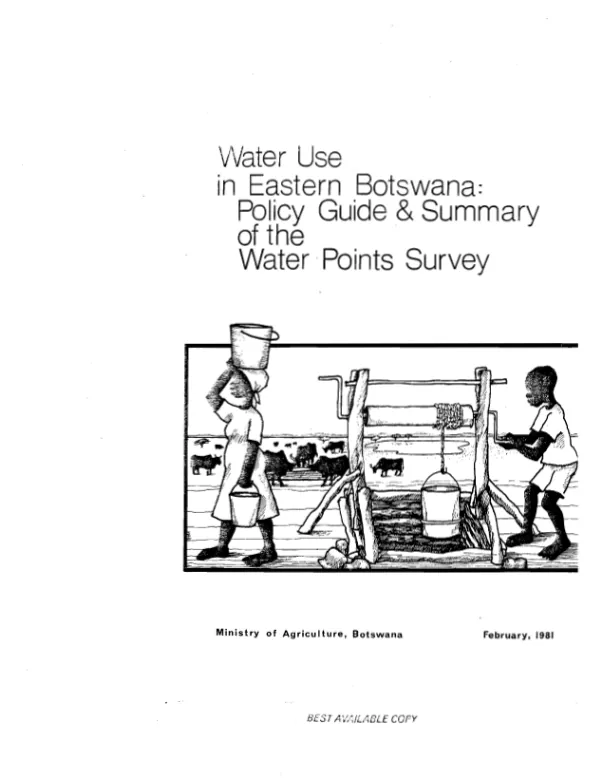
Water use in Eastern Botswana : policy guide and summary of the water points survey
A Water Points (WP) Survey was undertaken in Botswana"s eastern communal areas to study the effect on the cattle range of different physical types of WP"s and of WP management, identify those who benefit from publicly provided livestock water, and assess the effectiveness of group management of dams.
Roe, Emery; Fortmann, Louise P. · 1981
Sign in to readA free account is required to download.
Abstract
The survey showed that publicly-provided WP"s serve both rich and poor, although the rich are more likely to use them. Different WP types were found to affect range conditions differently, although in a less direct manner than originally assumed. Although WP"s owned by groups or the government have better dry season range conditions than those owned privately, some of this difference is due to the poorer range conditions around private open wells. There was no evidence that publicly-provided WP"s cause more damage, measured along a transect, than privately owned ones, nor that groups manage WP"s badly in comparison with private managers. Fewer range differences emerge when comparing physical types, and these center around open wells having poorer total grazing scores and greater bush encroachment than other types, especially boreholes. The type of access livestock users have to WP"s best explains differences in range conditions across the WP"s in the survey area. In l974, the Government of Botswana began building dams for livestock watering purposes, charging cattlemen with maintaining the dams, regulating water supplies, and raising money for operation and repair costs. The survey found that while the groups do not completely fulfill their responsibilities (being essentially seasonal ad hoc groups rather than permanent committees), the dams, after 5 years of use, are not in as bad a state as their predecessors and have not had a particularly negative affect on range conditions. Included are general and specific recommendations to improve water use and land use planning; guidelines for livestock and domestic water use projects, for choosing types of WP"s and sites for water development in the communal areas, and for group management of dams; a chronological list of 32 major consultancies and reports (l964-8l) relating to water use in eastern Botswana since the nation"s independence; and a ll0-item bibliography (l943-8l).
Related documents